
 English
 Español
 عربى
عربىA distributor in the Netherlands logged a return claim last quarter: a run of 460 ml kraft soup bowls leaked across the rim seal after 90 seconds at 900 W. The containers looked identical to the microwave-safe bowls the restaurant chain had purchased the previous year, and the paperboard was the same grade. The difference was the liner, and the failure was predictable. Microwavability in kraft soup containers is a lamination-specification problem, and it needs to be treated that way at the purchasing stage, not discovered in a customer kitchen.
Content
- 1 What Actually Limits Microwavability in Kraft Soup Containers
- 2 Polyethylene Lamination Limits: Softening, Delamination, Leakage
- 3 Polypropylene Lamination Extends the Microwave Ceiling to 140°C
- 4 The Test Protocol That Verifies Microwave Safety in a Soup Container
- 5 Sourcing Microwaveable Soup Containers: What to Write in an RFQ
- 6 Frequently Asked Questions on Lamination and Microwave Safety
What Actually Limits Microwavability in Kraft Soup Containers
The lamination film is the limiting component; paperboard stiffness and print quality are unchanged at reheat temperatures, but a polyolefin liner that softens will destroy the container. Microwavability depends on three measurable properties: the film's heat tolerance, heat-seal bond retention, and migration compliance under hot-food simulants.
Microwavability is the ability of a filled container to be heated in a domestic microwave oven for its stated duty cycle without leakage, delamination, visible deformation, or release of coating substances above regulatory migration limits.
A kraft soup bowl is a demanding microwave case because of four physical realities:
- Water in the soup reaches 100°C within the first 60 to 90 seconds of a 700 to 900 W cycle.
- Fat or oil-rich phases heat faster than water and can form 120 to 150°C micro-zones at the surface.
- The film just above the liquid line sees condensed steam plus radiant hot spots, so it is the first zone to soften.
- The lid rim seal expands more than the paperboard rim, which raises seal stress exactly where the film is weakest.
These four points explain why a raw-material data sheet is not enough; the finished container must be reheat-tested.
Polyethylene Lamination Limits: Softening, Delamination, Leakage
Polyethylene (PE) lamination is not microwave-safe for hot soup because PE film softens in the 95 to 105°C range, which is below the temperature a soup container reaches during normal reheating. LDPE is the default liner for cold and ambient packaging because it heat-seals at low temperature and blocks moisture on a shelf. Under microwave energy, however, the film relaxes, pulls away from the kraft board at the rim, and capillary action wicks soup into the exposed paper edge.
Distributor technical sheets are explicit about this. A widely used disposables selector lists kraft soup containers with lids as "not microwaveable" when the inside coating is PE, and groups polypropylene-based microwaveable containers as a separate heat-resistant class. The melt properties explain the classification:
| Property | LDPE (polyethylene) | PP (polypropylene) |
| Film melting range | 105 to 118°C | 160 to 165°C |
| Softening onset | 95 to 105°C | about 140°C |
| Typical coating weight on kraft soup bowls | 12 to 20 gsm | 12 to 20 gsm |
| Behaviour at boiling soup (100 to 110°C) | Softens and can delaminate | Stable, seal remains intact |
| Microwave recommendation for hot soup | Not recommended | Recommended |
In a 700 W reheat from 5°C to a 90°C core over two minutes, the liner temperature at the headspace can reach 110 to 120°C, above the softening point of LDPE. Film separation can therefore occur before any visible leak appears, which is why defective bowls often pass a cold-water fill test.
Once delamination starts, the barrier is gone. The bowl wicks moisture into the kraft fibres, loses stiffness, and can leak through the bottom radius within seconds. A "short burst" is also unreliable because hot spots move and the weakest seal decides the failure point.
The chart compares the practical heat ceiling of common food-contact films. Only polypropylene offers a clear margin above boiling soup.
Polypropylene Lamination Extends the Microwave Ceiling to 140°C
Polypropylene (PP) lamination is the microwave-grade answer; PP film melts at 160 to 165°C and keeps mechanical stiffness up to about 140°C, so the entire practical microwave range for soup reheating stays below its failure point. Extrusion-coated PP at 12 to 20 gsm bonds well to food-grade cast kraft, forms a strong lid seal, and does not soften during high-power bursts.
Low-odor polypropylene compounds have been developed specifically for microwaveable food-contact articles, and the technology is mature in the disposables industry. The performance difference appears in three specifications a buyer can verify:
Because PP stays rigid at reheat temperature, the rim seal retains its peel strength and the paperboard stays dry. That is why a responsible supplier labels a bowl "microwaveable" only when the liner is PP or an equivalent heat-resistant replacement, and why PE-lined bowls are limited to cold display and short ambient use.
If the product specification does not name the liner polymer, ask directly. "Kraft bowl" alone tells you nothing about microwave performance; "PP-lined kraft soup bowl" tells you the container was designed for reheating duty.
The Test Protocol That Verifies Microwave Safety in a Soup Container
A container earns a microwaveable claim only after a finished-article reheat test, not from a film certificate. The protocol below takes about 40 minutes, uses ordinary kitchen-lab equipment, and every step produces a number that can go in the procurement file.
- Reheat cycle. Fill the container to rated capacity with soup at 5°C and heat at 650 W for 2.5 minutes, or at 900 W for 2 minutes if the label claims high-power compatibility.
- Surface mapping. Immediately measure the inner wall temperature with an infrared probe and record blistering, curling, or film separation at the rim and bottom radius.
- Leak check. Invert the container for five minutes over a white tray; any droplet on the outer wall or tray fails the container.
- Seal retention. Measure the rim seal peel force before and after heating; the post-heat value must stay above 80 percent of the initial value.
- Migration. Run the overall migration test in 3% acetic acid at 100°C for 60 minutes; the result must stay below 10 mg/dm2.
| Checkpoint | Method | Pass limit |
| Visual integrity | 650 W reheat, 2.5 minutes from 5°C | No blister, no peel, no curl above the rim |
| Leak check | Invert for five minutes after reheat | No visible liquid on outer wall or tray |
| Seal retention | Peel force after reheat | At least 80 percent of initial force |
| Overall migration | 3% acetic acid, 100°C, 60 minutes | Below 10 mg/dm2 |
Ask the supplier for a test report that names the finished container, the coating film, the wattage, the time, the fill temperature, and the simulant. A report that says "raw material tested" does not verify the bowl as manufactured.
Sourcing Microwaveable Soup Containers: What to Write in an RFQ
The specification must name the liner polymer, not just the board. Write "extruded PP liner, food-grade kraft board, 12 to 20 gsm coating weight, validated at 900 W for three minutes" into the request, and require overall migration below 10 mg/dm2 at 100°C in an aqueous simulant. If the packaging is printed, put "PP-lined, microwaveable" on the technical drawing, not only on the label artwork.
A supplier with in-house lamination and cup-forming control can match coating weight to the forming dies and seal tooling, which is the main variable that separates a bowl that survives three minutes from one that fails at the rim. At Xuancheng Bo Site Commodity Co., Ltd. (papercup-factory.com), kraft soup bowls and takeaway containers are manufactured under the same extrusion-lamination control, so film type and coating weight are documented on the same sample that ships for testing.
- State the liner polymer: PP for microwaveable duty, PE only if the bowl is for cold display.
- Demand a finished-article reheat test at the wattage you will print on the pack.
- Request overall migration data at 100°C in an aqueous simulant.
- Confirm that the lid seal tooling is matched to the coating weight.
- Ask for production-lot peel-force sampling if you ship retail packs.
For hot-soup programs, choose the production line that already validates the finished geometry. The disposable microwaveable kraft paper soup bowl with paper lid is the reference article for this specification class. PE-lined bowls from the same factory family remain perfectly good for deli display and cold storage; they simply must not carry a microwave-safe claim.
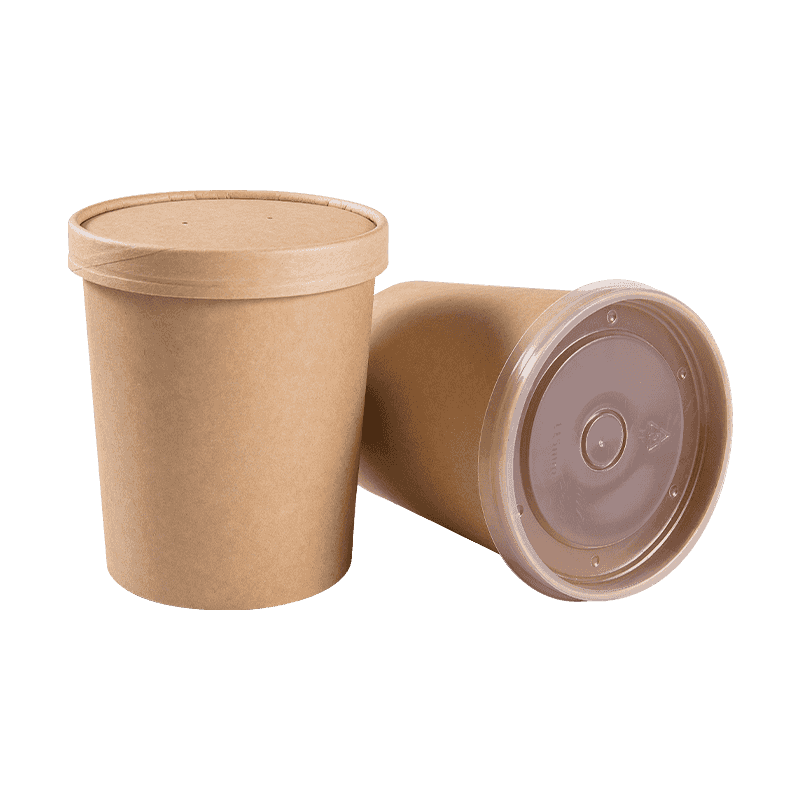 Microwave-Safe Kraft Paper Soup Bowl with Paper LidThis kraft paper bowl is positioned as the reference for microwave-safe hot-soup packaging, with a paper cover for sealing and a smooth rim. It suits validation-focused buyers seeking a disposable, biodegradable option.View Product →
Frequently Asked Questions on Lamination and Microwave Safety
Can a PE-lined kraft soup container go in the microwave even for a short time?
No. A 30-second burst keeps the average food temperature below the PE softening point, but microwave hot spots can still push the film above 100°C at the headspace or bottom radius. Leaks occur at the weakest seal, so a short cycle is not reliably safe across a production lot.
What temperature can a PP-lined soup container actually withstand?
A correctly manufactured PP-lined kraft soup container keeps its barrier and seal integrity up to roughly 140°C internal film temperature. That covers two- to three-minute reheating cycles in 650 to 1000 W domestic ovens, including liquid boiling and fat hotspots.
Is PLA lining safe for microwaving hot soup?
No. Polylactic acid film has a heat deflection temperature near 55°C, far below the boiling point of soup. PLA containers suit cold dishes and short shelf-life use; they are not a microwave substitute for PP.
What proof should a supplier provide for a microwaveable claim?
A finished-article test report that names the container, the coating film, the wattage, the time, the fill temperature, and the migration simulant. Overall migration must stay below 10 mg/dm2 at 100°C, and the supplier should sample seal peel force from production lots.
Microwavability in kraft soup containers is decided at the coating extruder, not in the cup-forming press. Specify PP for hot-soup duty, verify with a finished-article reheat test, and keep PE-lined bowls for cold programs.

 +86-0563-8029081
 +86-0563-8029081
 No. 12 Sanxi Road, Xinqiao Development Zone, Jingde Country, Xuancheng City, Anhui Province.