
 English
 Español
 عربى
عربىContent
- 1 Stacking Efficiency and Lid Fit Are Decided at the Rim
- 2 Round Kraft Salad Bowls: Deepest Nesting, Most Uniform Lid Contact
- 3 Octagonal Kraft Salad Bowls: Stiff Walls, Near-Round Rim Behavior
- 4 Rectangular Kraft Salad Bowls: Highest Carton Density, Narrowest Fit Window
- 5 Shape Comparison: Stacking, Density, and Lid Fit at a Glance
- 6 A 20-Minute Test Protocol for Lid Fit and Stacking
- 7 Frequently Asked Questions
Stacking Efficiency and Lid Fit Are Decided at the Rim
The rim geometry controls both behaviors before the wall shape matters. A continuous circular rim distributes lid pressure evenly, while a multi-sided rim introduces straight runs that must be curl-rolled to hold a lid. Wall taper adds a second variable: most kraft salad bowls use a 4 to 6 degree taper, and round walls nest along a smooth cone, whereas flat panels stack in small steps that add height to every column. That is why every spec sheet we write lists rim curl height and wall taper angle before material weight; those two numbers predict how the bowl behaves in a stack and under a lid.
Round Kraft Salad Bowls: Deepest Nesting, Most Uniform Lid Contact
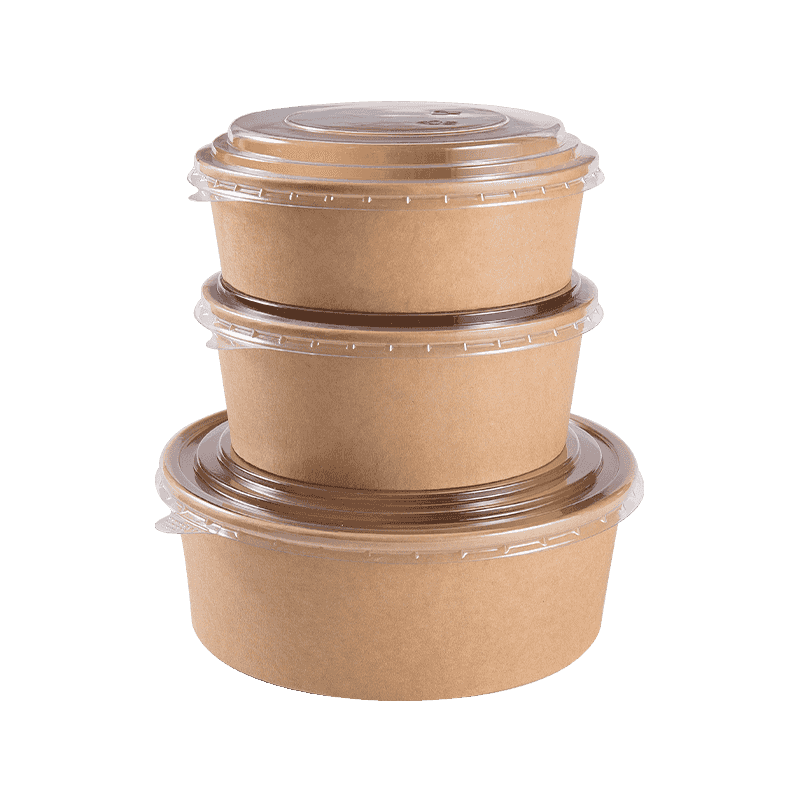 Kraft Paper Salad Bowl with Lid in 500ml, 750ml and 1000ml SizesThis round kraft bowl line offers three capacities and a consistent circular rim that improves lid seating. It suits grain bowls and soups, though round shapes reduce carton packing density.View Product →
Round bowls win on stacking and sealing consistency. Because the rim is one continuous arc, a standard 150 mm PET dome lid engages with even force around the entire circumference, and our QC records show under 0.5% lid seating failures on round rims. The trade-off shows up in the carton: a circle occupies only about 78.5% of its bounding square, so round bowls lose roughly one-fifth of the carton volume to corner gaps. Round bowls also work well for grain bowls and soup-adjacent formats because a spoon can reach every part of the bottom, but the circular footprint wastes tray and delivery-bag space when salads are packed side by side. For operators who lid hundreds of bowls per shift, the uniform rim keeps the line moving and the reject bucket empty.
Octagonal Kraft Salad Bowls: Stiff Walls, Near-Round Rim Behavior
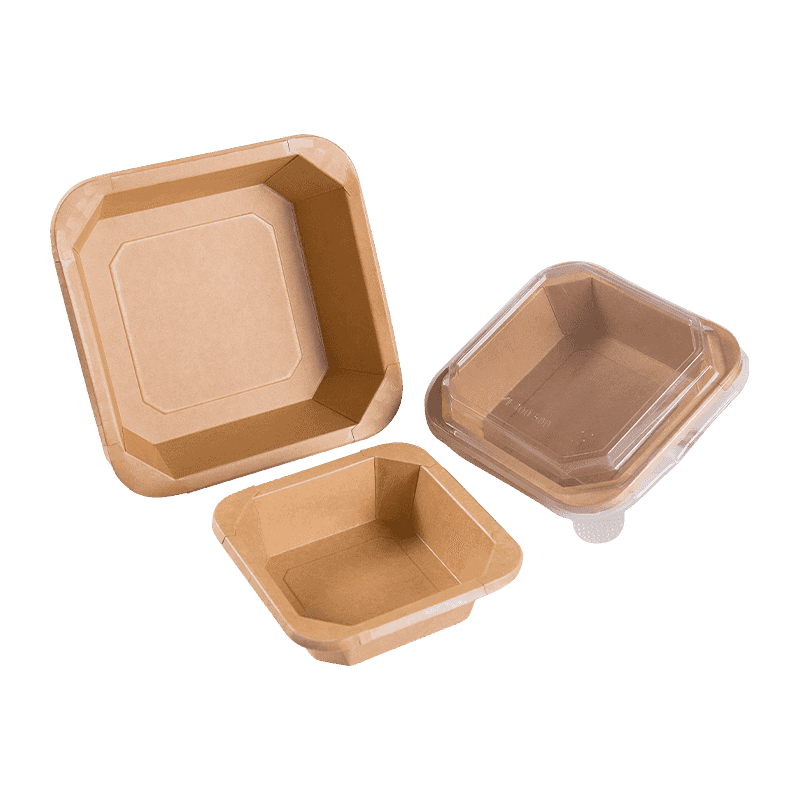 Disposable Kraft Octagonal Salad Bowl with PET CoverThe octagonal shape adds wall rigidity while accepting standard PET lids, balancing delivery durability with better carton density. It is a practical choice for meal prep and takeout.View Product →
Octagonal bowls are the compromise that usually works. The eight flat panels add wall rigidity without the long unsupported spans of a rectangle, so a filled bowl holds its shape better than a round one in a crowded delivery bag. Because the rim is still curl-rolled into a near-circular profile, most octagonal kraft salad bowls accept standard PET lids. The trade-off is corner variance: in caliper checks on our octagonal 750 ml bowl, rim diameter varies by 0.3 to 0.5 mm at the panel transitions, versus 0.1 mm on the round version. Stack height sits between the other shapes at about 53 cm per 100 bowls. Flat panels also align in a shipping carton, pushing density well above round. For a 750 ml portion, the octagon is the shape most likely to survive a 5 km delivery ride without lid pop-off, because the stiffened panels resist the sidewall flex that unseats round lids.
Rectangular Kraft Salad Bowls: Highest Carton Density, Narrowest Fit Window
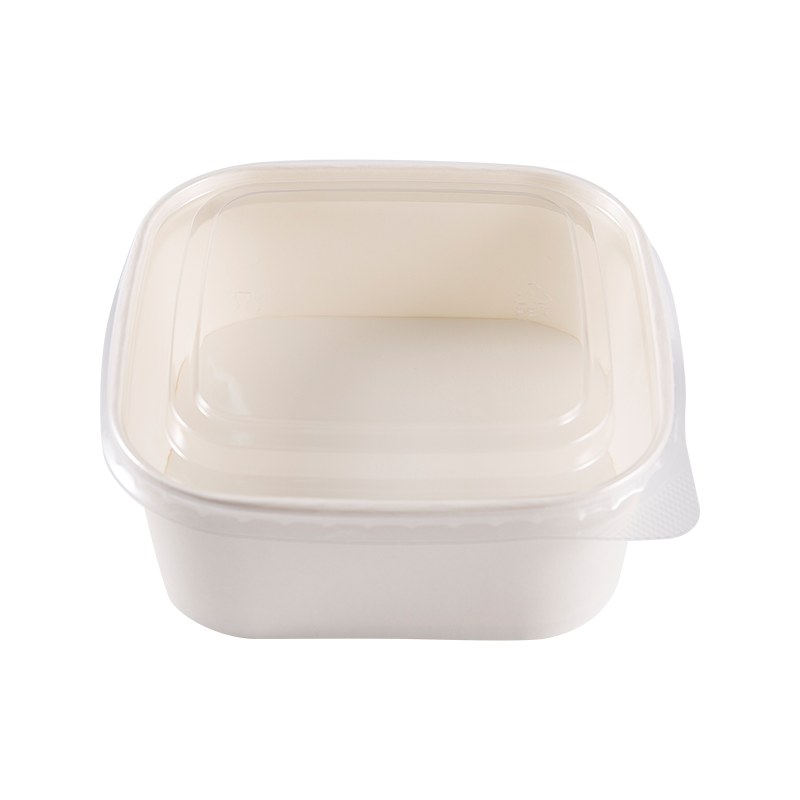 Disposable Biodegradable Square Kraft Salad BowlThis square kraft bowl maximizes carton density and shelf fit, but straight rim spans may cause higher lid rejection. It suits meal-prep operators who prioritize volume and alignment.View Product →
Rectangular and square kraft salad bowls deliver the best case density and the least forgiving lid fit. Flat walls sit flush against carton walls and against each other; a typical 750 ml rectangular bowl returns 650 to 680 units in a 60 x 40 x 30 cm carton, versus about 360 for round. The problem is the long straight rim spans, which can bow during forming or when coated paperboard dries unevenly. When the flange bows, a PET lid seats at the center of each side and lifts at the corners. Our line-side study found 1.5 to 2.5% lid seating rejects on rectangular models, roughly three to five times the round rate. Corner creases also thin the barrier coating, so dressing-heavy salads raise the leak risk at the two lowest corners. Meal-prep operators tend to prefer rectangular bowls because protein, grains, and vegetables align in straight rows, and the flat base sits flush on refrigerator shelves.
Shape Comparison: Stacking, Density, and Lid Fit at a Glance
All three shapes can be made to work with the right rim tolerance and coating. The measured differences below assume the same 750 ml nominal volume, 300 gsm PE-coated kraft board, and a curl-rolled rim on every model.
| Property | Round | Octagonal | Rectangular |
| Stack height per 100 bowls | 42 cm | 53 cm | 65 cm |
| Rim lid-seat deviation | 0.1 mm | 0.5 mm | 1.5 mm |
| Bowls per 60 x 40 x 30 cm carton | about 360 | about 520 | about 680 |
| Corner leak risk at folds | None | Low | Moderate |
| Stability on trays and in delivery bags | Low | Medium | High |
The density gain is real, but it compounds the lid problem. In our experience, buyers who switch to rectangular shapes to cut carton costs should budget for a matched PET lid with a deeper skirt and a rim curl of at least 2 mm; otherwise the savings in cardboard disappear in leaked dressing and popped lids.
A 20-Minute Test Protocol for Lid Fit and Stacking
Before committing to a container program, run this warehouse test on samples from three different production lots. It exposes the shape defects that survive a brochure spec sheet.
- Nest 50 bowls of each shape, measure the full column, and divide by 50. Repeat three times; if the per-bowl nesting height varies by more than 0.2 mm between lots, the supplier cannot control wall taper.
- Check rim ovality with calipers at four positions on the same bowl. Accept 0.5 mm maximum deviation for round, 1.0 mm for octagonal, and 1.5 mm for rectangular. Higher numbers predict lid blow-off in the field.
- Seat a lid on 25 filled bowls, fill each to 200 g, and hold them inverted for 60 seconds. Count the reseating failures: any lid that pops or weeps fails the rim spec for your use case.
- Flex each corner of a rectangular or octagonal bowl ten times and inspect the crease line for coating cracks. Cracks at the bend point become leaks before the shelf-life date.
Frequently Asked Questions
Which kraft salad bowl shape stacks the lowest?
Round kraft salad bowls stack lowest because a continuous 4 to 6 degree taper nests with no panel steps. A stack of 100 round 750 ml bowls measures about 42 cm, against 53 cm for octagonal and 65 cm for rectangular.
Do octagonal kraft salad bowls fit standard PET lid sizes?
Only when the rim is curl-rolled to a circular profile before lidding. Octagonal walls do not dictate the lid; the rim does. Check the rim diameter after forming and confirm the lid seats under finger pressure with no visible gaps at any of the eight transitions.
Why do rectangular kraft salad bowls leak at the corners?
The crease lines that form the corners thin the PE or PLA barrier during press-forming, and dressing pools in the corners under transport vibration. A curl-rolled rim fixes the lid seal, but corner leakage is a material and crease-design issue that requires testing, not guesswork.
How much carton space can switching from round to rectangular save?
For 750 ml bowls in a 60 x 40 x 30 cm carton, round packs about 360 units, octagonal about 520, and rectangular about 680. Switching from round to rectangular cuts the carton count by roughly 47% for the same number of bowls, before considering the lid and stacking trade-offs.

 +86-0563-8029081
 +86-0563-8029081
 No. 12 Sanxi Road, Xinqiao Development Zone, Jingde Country, Xuancheng City, Anhui Province.