
 English
 Español
 عربى
عربىWhen a 220 g double burger with a side of fries leaves the pass at 64 degrees Celsius, the countdown starts. In a sealed clamshell, the hot patty pushes headspace humidity toward saturation within minutes, condensation beads on the lid, the bun softens, and the box walls begin to bow under the weight above them. Every burger order therefore tests two packaging properties at the same time: how well the box holds its shape, and how quickly it lets steam escape. The first ensures the meal arrives looking like a burger; the second ensures it still tastes fried.
Choosing clamshell kraft burger boxes for a takeout menu is not a packaging decision; it is a quality-control decision with measurable consequences. A box that prioritizes rigidity alone traps moisture. A box that vents generously loses heat and structural reserve. Board weight, fold geometry, vent placement, and coating systems interact in ways that this guide breaks down, along with the verification steps that matter for real delivery conditions.
Content
- 1 Structural Rigidity of Clamshell Kraft Burger Boxes: What Stops a Stack from Collapsing
- 2 Breathability: Why Steam Handling Decides Whether Fried Food Stays Crisp
- 3 Breathability vs. Rigidity in Clamshell Kraft Burger Boxes: Designing the Middle Ground
- 4 Three Five-Minute Box Tests to Run Before You Order in Bulk
- 5 Frequently Asked Questions About Clamshell Burger Box Selection
Structural Rigidity of Clamshell Kraft Burger Boxes: What Stops a Stack from Collapsing
 Disposable Food Grade Kraft Paper Burger Fast Food Packaging BoxThis reinforced kraft clamshell is engineered to keep its rectangular footprint under vertical compression, making it a practical choice for takeout rigidity tests. Its leak-resistant base and easy-open design support clean handling in real delivery conditions.View Product →
Structural rigidity is the ability of a clamshell to preserve its rectangular footprint and flat lid under vertical compression, and it is engineered, not assumed.
Basis weight is the first lever. Food-grade kraft clamshells for burgers typically use 300 to 450 gsm boards. A 350 gsm single-wall board handles a single burger with a lock tab; a 400 to 450 gsm board, or a fluted construction, carries stacked double burgers without the lid springing open. Above 450 gsm, stiffness gains slow while material cost and die-cutting difficulty climb.
Fold lines matter as much as the board itself. Deep, precisely positioned score lines create a sharp 90-degree fold with spring-back resistance. Combined with a rimmed lid edge and a tab-and-slot closure, the whole box behaves like a small load-bearing structure. Vent size and print coverage change very little if the score geometry is wrong; conversely, good scoring can compensate for a slightly lighter board.
- Basis weight controls wall stiffness and vertical load capacity.
- Score depth and crease position determine fold accuracy and spring-back.
- Lid rim profile and closure tabs distribute stacking pressure across the box perimeter.
A practical rule for kitchens: a filled clamshell should hold at least five more filled boxes on top of it for ten minutes without the bottom row losing its rectangular outline. The burger carton that fails this test will fail in a delivery bag first.
Breathability: Why Steam Handling Decides Whether Fried Food Stays Crisp
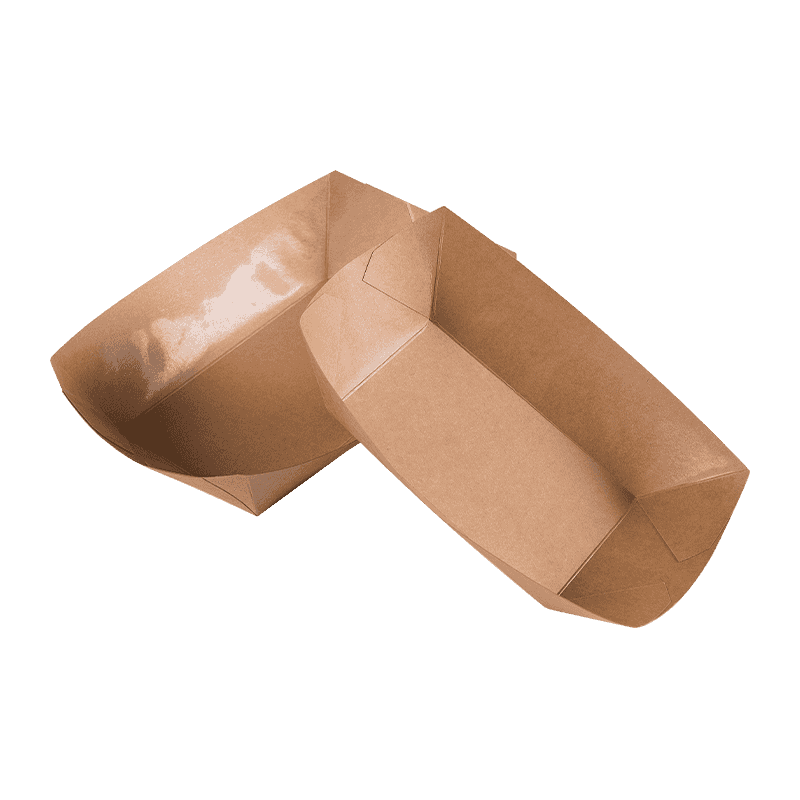 Disposable Kraft Paper Boat-shaped Tray for Fried Chicken and FriesThis boat-shaped kraft tray offers oil absorption and breathability, helping fried sides stay crisp. Its reinforced base keeps loaded trays stable, and the biodegradable material supports eco-friendly takeaway service alongside the main clamshell.View Product →
Breathability is the rate at which water vapor escapes through the box walls, vents, and seams, and fried food keeps its texture only when the interior microclimate stays below roughly 85 percent relative humidity.
Once the lid closes over a hot patty, evaporation creates a saturated microclimate. Because water vapor migrates toward the cooler lid, condensation forms and drips back onto the bun and the fries. The result is a texture collapse that no reheating can reverse. In shelf-life tests run by packaging suppliers, bite-force values for fried coatings drop by about one-third after ten minutes in a saturated clamshell compared with a vented one.
Three design levers control breathability:
- Vent openings: two to four round or angled vents of 3 to 6 mm release enough steam to prevent condensation pooling without letting the burger cool too fast.
- Wall construction: fluted and corrugated kraft structures create internal air channels that help vapor migrate toward the seams; solid single-wall board transmits vapor mostly through the coating and the vents.
- Coating system: PE film is an effective vapor barrier, which makes a sealed PE-lined clamshell the fastest way to surrender crispiness. Water-based barrier coatings and PLA linings allow measurable vapor transmission while still blocking grease.
Even with the right vents, the side pocket carrying fries needs its own escape path. High fries in the box compete with the burger for air volume; a dedicated kraft boat tray, placed beside the clamshell, keeps fries drier and makes the unboxing experience feel intentional.
Breathability vs. Rigidity in Clamshell Kraft Burger Boxes: Designing the Middle Ground
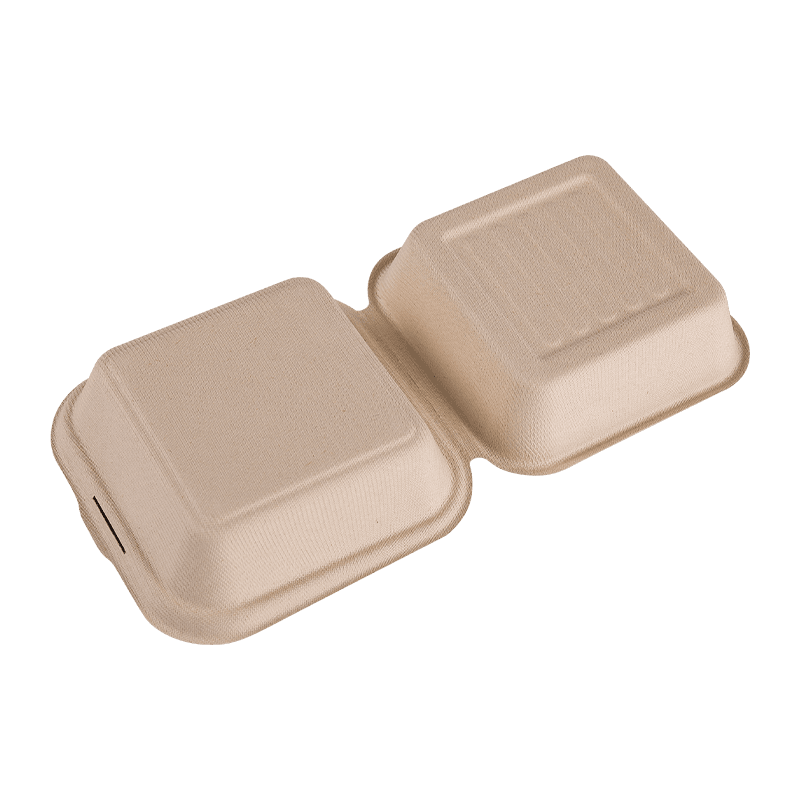 Sugarcane Bagasse Square Takeaway Burger Lunch ContainerMade from bagasse, this square container adds moisture resistance and toughness to protect burgers and salads in transit. Its stackable shape saves storage space, and the easy-open design suits fast-paced takeaway operations while keeping food presentation intact.View Product →
The trade-off between structural rigidity and breathability never entirely disappears, but material selection and vent distribution can shift the balance in measurable ways.
Fluted kraft board, the same logic used in double-wall coffee cups, offers a high rigidity-to-weight ratio while creating air channels that improve moisture escape. Molded bagasse fiber sits at the opposite end: it is the most breathable material of the three, but its lower density means a thicker wall is needed to reach the same stacking strength. Coating choice also moves the line: a PE coating maximizes oil holdout but blocks vapor; a water-based barrier coating allows more vapor exchange while still protecting the packaging from grease stains.
Rigidity protects structure
- Keeps the lid flat and stackable at the pick-up counter.
- Prevents wall buckle under the weight of bags and drink carriers.
- Preserves burger shape during rider transport.
Breathability preserves texture
- Releases steam before it condenses on the crown bun.
- Stops fried coating from absorbing droplet moisture.
- Keeps dedicated fry pockets from turning into steam pockets.
In practice, most takeout menus reach a sensible middle: a 350 to 400 gsm fluted kraft clamshell, with two to four small vents, a tab lock, and a water-based coating. If the order is built around crispy fried chicken or loaded fries, a bagasse molded box trades a little stacking stiffness for significantly better moisture escape.
| Material system | Rigidity (0-10) | Breathability (0-10) | Best suited for |
| Solid kraft 300-380 gsm | 8.5 | 4.0 | Single-burger carryout, branded print |
| Fluted / corrugated kraft | 9.0 | 5.5 | Double burgers, stacked catering orders |
| Bagasse molded fiber | 6.8 | 8.2 | Crispy fried items, eco-positioned menus |
How the three material systems compare: rigidity versus breathability
Three Five-Minute Box Tests to Run Before You Order in Bulk
You can validate rigidity and breathability with three kitchen tests before signing a large order; no laboratory equipment is required, only a heat source, a timer, and a filled burger.
- Steam-lid test: place a freshly fried burger with hot fries inside the closed clamshell, wait five minutes, then open it. If droplets cover the lid or the bun surface feels wet, venting is insufficient. If the box skin turns greasy, the barrier coating is failing.
- Stack test: fill five boxes with identical burgers, stack them, and wait ten minutes. Measure any sidewall bulge with a ruler; more than 5 mm of deflection indicates a board weight or score-geometry problem.
- Seam tilt test: hold a filled box at a 20-degree angle for two minutes and inspect the corner seams and lock tabs. Seepage here predicts leak complaints in delivery bags far better than any glossy spec sheet.
Vendor qualification matters as much as box performance. Xuancheng Bo Site Commodity Co., Ltd., a food-contact paper packaging manufacturer in Anhui, China, has supplied burger cartons, kraft boat trays, and takeaway kraft boxes to export and food-service customers since 2008; it holds ten invention patents, ten utility-model patents, and reports an installed capacity of more than one billion paper containers per year. A supplier of this type can usually provide documented basis weights, coating systems, and full product range files before you request a sample shipment.
Frequently Asked Questions About Clamshell Burger Box Selection
Do kraft clamshell boxes leak oil through the paper?
Only if the coating is wrong for the food. Solid kraft paper alone absorbs grease quickly. Board coated with PE, PLA, or a water-based grease barrier holds oil at the seam and lock area for the duration of a normal delivery. Water-based coatings handle moderate grease and are more recyclable, while PE offers higher oil holdout but blocks vapor transmission.
Should every burger box have vent holes?
No. Venting helps hot fried components release steam, but it can dry out a burger with heavy wet toppings such as tomatoes, sauces, or coleslaw. A balanced approach is a small number of small vents (3 to 4 mm) positioned above the patty line, with the vents located on the lid panel rather than the side walls so structural rigidity is not weakened.
What grammage is needed for a double-burger clamshell?
Plan on 400 gsm or a fluted construction for double burgers. A single-wall 350 gsm box can hold weight at the bottom, but the lid and the center hinge are the first to deform when boxes are stacked. If the menu also includes fries inside the same clamshell, consider a vented fluted design instead of a heavier solid board.
Can clamshell kraft burger boxes be microwaved?
Only when the box is explicitly labeled microwave-safe by the manufacturer. Standard kraft clamshells with PE film or metal-free inks may not survive high heat without delamination. If reheating is part of the customer experience, specify a microwave-safe water-based coated box and verify the claim with the supplier's test report.




 +86-0563-8029081
 +86-0563-8029081
 No. 12 Sanxi Road, Xinqiao Development Zone, Jingde Country, Xuancheng City, Anhui Province.