
 English
 Español
 عربى
عربىContent
The Retro Paper Cup: A Design Icon That Never Went Away
Retro paper cups — particularly those from the 1980s and 1990s — have become one of the most recognizable pieces of disposable design in American visual culture. What started as a functional foodservice product has evolved into a full-blown aesthetic reference point, appearing in contemporary branding, graphic design, and nostalgia-driven merchandise decades after the originals were retired. The renewed interest in 80s paper cup and 90s paper cup designs is not mere sentimentality; it reflects how deeply these objects embedded themselves in everyday life during two of the most visually distinct decades of the twentieth century.
For anyone who grew up getting a fountain soda at a convenience store, a water cup at the dentist, or a coffee at a diner between 1978 and 1999, these cups carry an almost involuntary sense of recognition. The specific color palettes, the abstract geometry, and the confident graphic boldness of those designs are immediately legible as belonging to a particular time — which is precisely why they continue to resonate.
80s Paper Cup Design: Bold, Geometric, and Unapologetically Loud
The visual language of 80s paper cups was shaped by the broader graphic design trends of the decade: Memphis Group influence, neon color theory, and a general rejection of the subdued earth tones that had defined the 1970s. Paper cup design in the 1980s leaned hard into high contrast, geometric patterning, and saturated color combinations that would be considered aggressive by the muted standards of contemporary packaging.
Common design elements found on 80s paper cups include:
- Diagonal stripe patterns — often in two or three colors, running at a 45-degree angle around the cup body. Hot pink, cobalt blue, and black was a particularly common combination.
- Confetti and scattered shape motifs — triangles, squiggles, dots, and irregular polygons scattered across the surface with no apparent order, an aesthetic borrowed directly from Memphis-era decorative arts.
- Gradient color fields — particularly peach-to-coral and cyan-to-purple gradients that echoed the airbrush illustration style popular in 1980s commercial art.
- Oversized sans-serif typography — brand names and slogans set in wide, blocky letterforms that occupied a large portion of the cup surface.
The most iconic example of 80s paper cup design is arguably the Sweetheart Cup Company's various hot cup patterns, which circulated through tens of thousands of diners, cafeterias, and office break rooms throughout the decade. Their designs were functional — high enough contrast to be visually legible in a busy environment — and produced at scale using flexographic printing, which constrained color count but rewarded bold, flat graphic work.
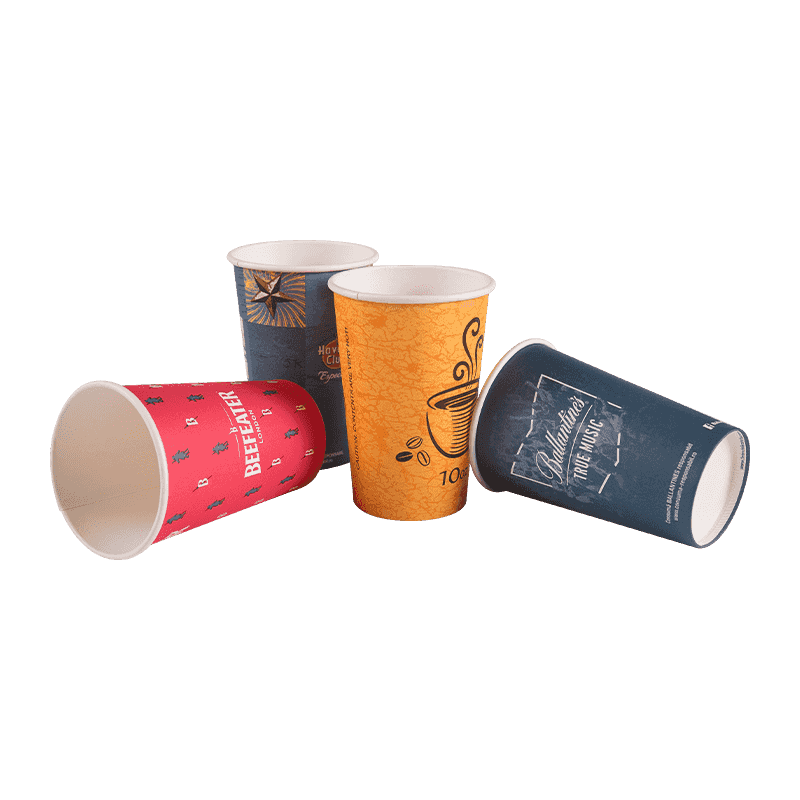
The Paper Cup Pattern That Defined the 90s
If the 1980s were defined by geometry and neon, the 1990s brought a shift toward organic abstraction and a slightly cooler, more restrained palette — though "restrained" is relative when teal, purple, and terra cotta were sharing the same cup. The most culturally significant paper cup pattern of the 1990s is the Jazz pattern, designed by Gina Ekiss for the Solo Cup Company in 1992.
The Jazz pattern — featuring a stylized abstract coffee steam motif in teal, purple, and dark blue on a white background, with geometric star and squiggle accents — became the default visual identity of disposable hot cups throughout the mid-1990s. It appeared in hospital waiting rooms, college cafeterias, convention centers, fast food restaurants, and workplace kitchens across North America and beyond. Estimates suggest billions of Jazz-pattern cups were produced and distributed between 1992 and the early 2000s, making it one of the most widely distributed pieces of graphic design in history by sheer unit volume.
The Jazz pattern's cultural footprint is significant enough that Solo Cup Company rereleased it in 2022 as a limited-edition nostalgia product, responding to organic demand from consumers who had been sharing images of original Jazz cups on social media for years. The rerelease sold out rapidly, confirming that the 90s paper cup pattern had transcended its original disposable context to become genuine collectible design heritage.
Other notable 90s paper cup design trends alongside Jazz include:
- Southwestern and tribal-inspired geometric patterns — earthy reds, turquoise, and sand tones drawing on the design vocabulary that dominated American home decor and casual dining in the early 1990s.
- Sports and "active lifestyle" graphics — silhouettes of cyclists, runners, and basketball players alongside diagonal speed lines, reflecting the decade's obsession with athletic culture.
- Nature and environmental motifs — leaves, waves, and sun imagery that aligned with the growing environmental consciousness of the era, sometimes paired with recycling messaging on the cup body.
Why Retro Paper Cups Are Having a Cultural Moment
The current enthusiasm for retro paper cup aesthetics is part of a broader pattern in how Gen X and Millennial consumers relate to the material culture of their childhoods. Objects that were entirely mundane at the time — designed for single use and immediate disposal — have acquired significance precisely because of their ubiquity. A paper cup was not meant to be remembered; the fact that it is remembered so vividly speaks to how saturated everyday environments were with these designs.
Social media has accelerated this phenomenon considerably. Images of original Jazz pattern cups, Sweetheart diner cups, and similar artifacts circulate widely on platforms like Reddit, Instagram, and Pinterest, generating threads of collective recognition that often reach hundreds of thousands of engagements. This organic nostalgia has created real commercial demand: retro paper cup designs now appear on T-shirts, phone cases, tote bags, enamel pins, and fine art prints, as well as on contemporary food and beverage packaging intentionally designed to evoke the era.
For brands operating in the food, beverage, and hospitality space, referencing 80s or 90s paper cup aesthetics carries specific associations: accessibility, informality, pre-digital authenticity, and a kind of democratic everydayness that premium branding often struggles to convey. A coffee brand using a Jazz-adjacent pattern on its cups is signaling something different from a brand using clean minimalist design — it is invoking the experience of ordinary American life at a specific historical moment.
Retro Paper Cup Design in Contemporary Branding and Production
Businesses and designers looking to incorporate retro paper cup aesthetics into current projects have several practical paths available:
Custom Cup Printing with Period-Accurate Design
Modern flexographic and digital printing technology can reproduce the flat, bold color fields of 1980s cup design or the slightly more complex patterning of 1990s cups with high fidelity. Minimum order quantities for custom-printed paper cups have dropped significantly over the past decade — many suppliers now offer short runs of 1,000 to 5,000 units, making retro-themed cups viable for independent cafés, pop-up events, and limited-edition brand campaigns rather than only large-scale foodservice operations.
When briefing a designer or print supplier on retro paper cup aesthetics, the most useful references are specific: naming the decade, the color palette, and the specific motif type (geometric, abstract, nature-based) produces more accurate results than a general request for "vintage" or "nostalgic" styling, which could be interpreted across a very wide range of visual references.
Design Resources and Pattern Libraries
For designers working digitally, vector recreations of classic paper cup patterns are available through stock illustration platforms and independent designers on marketplaces like Creative Market and Etsy. Original 80s and 90s paper cups in various conditions also surface regularly on eBay and specialist ephemera dealers — these are useful both as collector items and as physical reference materials for reproduction work. Museum collections including the Cooper Hewitt Smithsonian Design Museum hold examples of significant commercial packaging design from the period that are accessible through their online archives.
Licensing and IP Considerations
Some of the most recognizable retro paper cup patterns — including the Jazz design — remain under copyright held by their respective owners. Reproducing these patterns commercially without a license is an infringement risk regardless of their age, as many were created in the 1990s and remain within copyright term. Creating inspired-by designs that reference the visual language of the era without directly copying protected artwork is the standard approach used by contemporary brands working in this aesthetic space. The core elements — the color relationships, the geometric vocabulary, the general compositional approach — are period conventions, not proprietary; specific graphic arrangements are what intellectual property law protects.

 +86-0563-8029081
 +86-0563-8029081
 No. 12 Sanxi Road, Xinqiao Development Zone, Jingde Country, Xuancheng City, Anhui Province.