
 English
 Español
 عربى
An 82-store coffee chain in Germany added a line to its 2027 cup tender: every takeaway cup must biodegrade in an industrial composting facility. The procurement team's shortlist — PLA lined vs. water-based coated vs. PE coated cups — looked uniform in the cup dispenser, yet the three constructions had almost nothing in common at the waste stage.
That is why "compostable paper cup" is an unreliable label on its own. Each lining reacts to a different set of composting conditions, and what looks like a small packaging change actually rewires a brand's waste handling and compliance strategy.
Content
- 1 PLA Lined vs. Water-Based Coated vs. PE Coated Cups: Why the Lining Controls Biodegradability
- 2 PE Coated Cups: No Composting Condition Makes PE Biodegradable
- 3 PLA Lined Cups: Biodegradable Only under Industrial Composting Conditions
- 4 Water-Based Coated Cups: Biodegradability without the Composting Bottleneck
- 5 Composting Conditions Compared: PLA Lined vs. Water-Based Coated vs. PE Coated Cups
- 6 How to Choose between PLA Lined, Water-Based Coated, and PE Coated Cups
- 7 Frequently Asked Questions about PLA Lined vs. Water-Based Coated vs. PE Coated Cups
PLA Lined vs. Water-Based Coated vs. PE Coated Cups: Why the Lining Controls Biodegradability
The lining is the single dominant factor that decides whether a cup biodegrades, because bacteria and heat can reach the paper fibers only after the inner film has broken down.
A PE coated cup is paper bonded to a polyethylene film, a synthetic polymer that no common environmental microorganism metabolizes in a relevant timeframe. A PLA lined cup is paper bonded to polylactic acid, a bio-based polymer that hydrolyzes when heat and moisture cooperate. A water-based coated cup is paper treated with a thin dispersion of acrylic copolymers, and several formulations are designed to disintegrate in home compost or a standard paper recycling pulper within weeks.
A material is industrially compostable only if at least 90% of its carbon converts to CO2 within six months, at least 90% of its mass disintegrates through a 2 mm sieve within twelve weeks, and the resulting compost passes plant toxicity tests.
PE Coated Cups: No Composting Condition Makes PE Biodegradable
PE coated cups are not biodegradable under any realistic composting condition, because polyethylene is a synthetic polymer that microorganisms cannot metabolize at meaningful speed.
Polyethylene extrusion coating has been the industry default since the 1960s for good reasons: it is inexpensive, seals well, and holds hot liquids for long service windows. The trade-off appears in waste handling. A PE lined cup is a composite of fiber and plastic that almost no materials recovery facility can separate; paper mills reject it because the film contaminates the pulp, and plastic recyclers reject it because fiber jams their sorting equipment.
Common landfill estimates put PE film degradation beyond 400 years. For any composting operation — industrial, backyard, or vermicompost — PE fails every acceptance test, so choosing PE coated cups closes the composting route before the cup reaches a bin.
PLA Lined Cups: Biodegradable Only under Industrial Composting Conditions
PLA lined cups biodegrade reliably only inside an industrial composter that sustains 55-70°C with high moisture for weeks; in a home bin, marine environment, or landfill, they persist much like conventional plastics.
PLA is produced from fermented plant starch and polymerized into polylactic acid, so it is bio-based but still a plastic. Its breakdown starts with hydrolysis, a reaction that requires sustained heat. Industrial compost facilities typically hold 55-70°C during the first process weeks, which is why leading PLA cup formulations carry valid EN 13432 certificates. The same cup buried in a backyard pile, where temperatures rarely reach 40°C, shows little structural change after 12 months.
There is a second condition that has nothing to do with chemistry: collection. If the municipality does not run source-separated organic waste collection feeding an industrial composter, a certified PLA cup is hauled to a landfill or incinerator, and the degradation principle behind a biodegradable single-wall paper cup never becomes relevant in practice.
Water-Based Coated Cups: Biodegradability without the Composting Bottleneck
Water-based coated cups combine a barrier film thin enough for standard paper repulping with formulations that can pass home-compost certification, making them the most forgiving choice across composting conditions.
Water-based coatings are applied as a liquid dispersion and dried onto the cup surface rather than extruded as a separate film. The result is a much thinner layer: typical coating weight is 5-12 g/m², compared with 20-30 g/m² for PLA and 20-25 g/m² for PE. At that thickness the fiber stays easy to recover, and several commercial formulations have passed both industrial compost standards and home-compost standards such as NF T 51-800.
The practical limits are heat and grease resistance. A water-based cup generally holds hot beverages well for standard coffee service, but formulations with very high grease repellency may use polymer blends that no longer meet home-compost timelines, so buyers need to verify each specification rather than assuming every water-based cup is identical.
For foodservice operators the decisive advantage is flexibility: a water-based coated cup can move between composting, paper recycling, and general waste without crippling contamination in any single stream.
Composting Conditions Compared: PLA Lined vs. Water-Based Coated vs. PE Coated Cups
Across the four criteria that matter for real waste infrastructure — industrial compost, home compost, paper recycling, and landfill persistence — water-based linings lead, PLA follows under controlled heat, and PE trails in every category.
| Criterion | PE Coated | PLA Lined | Water-Based Coated |
| Base material | Polyethylene film | Polylactic acid film | Acrylic copolymer dispersion |
| Typical coating weight | 20-25 g/m² | 20-30 g/m² | 5-12 g/m² |
| Industrial compost (EN 13432) | Fails | Passes | Passes, formulation dependent |
| Home compost | Fails | Usually fails | Often passes |
| Paper recycling (repulping) | Low fiber recovery | Difficult separation | High fiber recovery |
| Landfill behavior | 400+ years | Very slow persistence | Faster breakdown, varies |
| Heat resistance for hot drinks | Excellent | Good | Good |
Typical coating weight of a 12 oz cup lining (g/m², lower is easier to compost)
How to Choose between PLA Lined, Water-Based Coated, and PE Coated Cups
Match the lining to the waste system your customers actually have access to, not to the most attractive label printed on the cup.
If the target market operates source-separated organic collection that feeds an industrial composter, as in parts of Italy, Austria, France, and the Netherlands, PLA lined cups are a defensible choice and will usually carry the required certificate. If cups will instead flow into mixed recycling or general waste, choose a water-based formulation, because it degrades under a wider band of conditions and does not contaminate the paper recycling stream. If the buying decision is dominated by the lowest unit cost and no compost infrastructure exists locally, PE remains the technical baseline, although exposure to plastic taxes and extended producer responsibility fees will keep rising.
Specify certified PLA or water-based cups, confirm that the local composter accepts fiber-based packaging, and keep lot-level certificates on file.
Avoid PLA, which will be treated as residual waste, and use water-based coated cups so the fiber can still be recovered in paper mills.
- Request the lining specification and compost certificate for the exact SKU you plan to order, not a generic brochure claim.
- Run a heat-retention test at your actual serving temperature, typically 70-85°C, and a leak test at the longest delivery time.
- Confirm with the local waste operator whether compostable cups are accepted in the organic bin in your municipality.
- Label the cup with the disposal instruction your market requires, avoiding vague biodegradable language that regulators increasingly penalize.
Buyers working with one supplier can simplify the process. Xuancheng Bo Site Commodity Co., Ltd., with PE, PLA, and water-based coating lines at its plant in Anhui, China, produces all three constructions under one quality system, so a brand can switch lining chemistry per market without requalifying an entire vendor list.
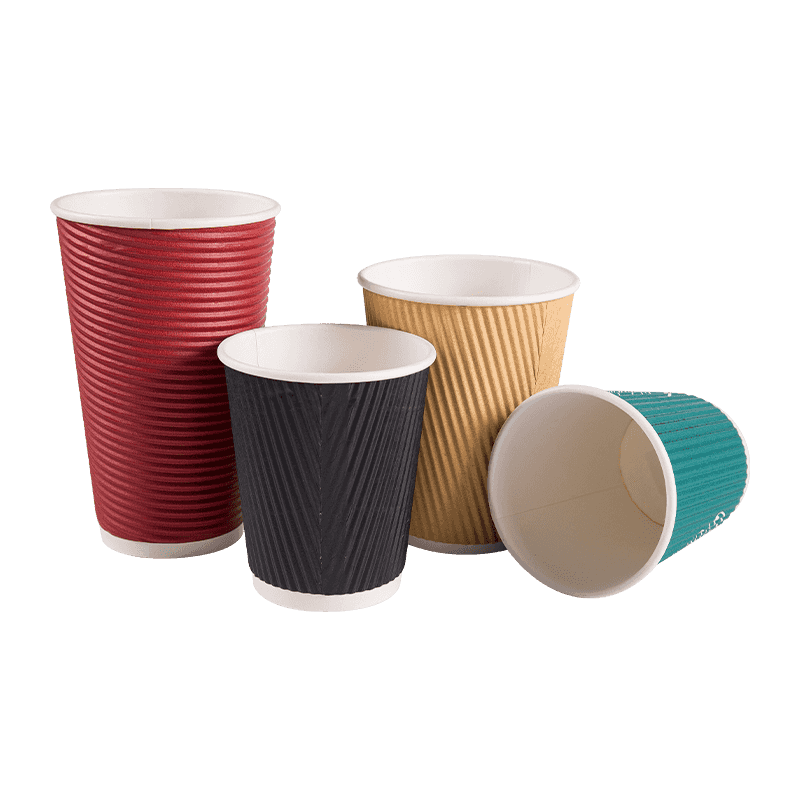
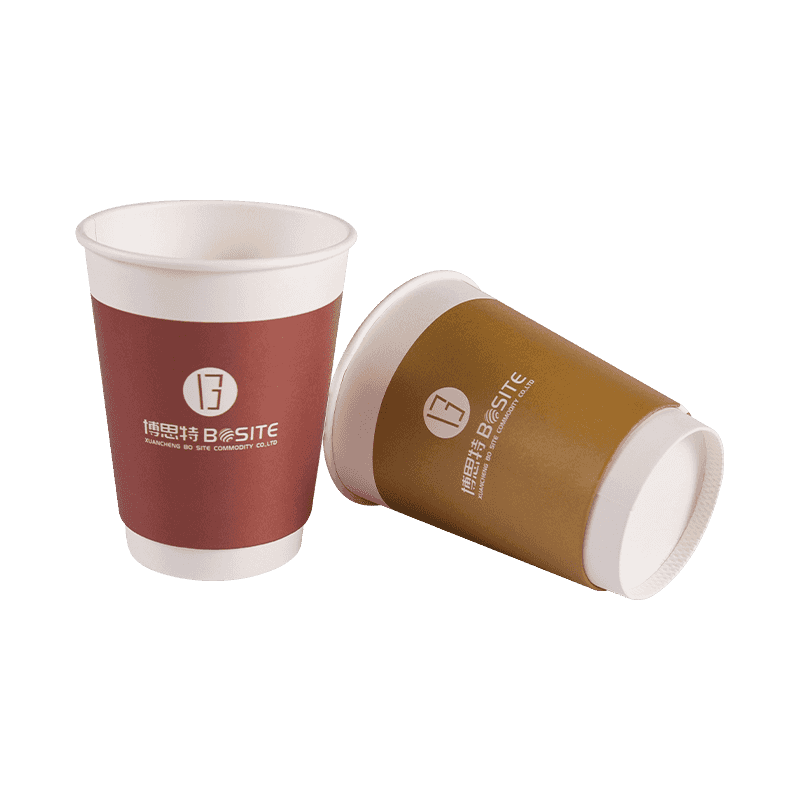 Biodegradable Double Wall Hot & Cold Drinks Paper CupThe Biodegradable Double Wall Hot Cold Drinks Paper Cup features advanced bio-based materials in its main structure, processed through specialized techniques to signif...View Product →
Frequently Asked Questions about PLA Lined vs. Water-Based Coated vs. PE Coated Cups
Can PLA lined cups be composted at home?
Most PLA lined cups fail home-compost standards because backyard piles do not hold 55-70°C long enough for hydrolysis. Only cups explicitly certified for home composting under standards such as NF T 51-800 should be marketed that way.
Are water-based coated cups plastic-free?
Not necessarily. Water-based coatings often contain acrylic or vinyl-acetate copolymers, which are polymers. The useful distinction is functional: the coating is thin enough for repulping and, in certified formulations, biodegrades under tested conditions, unlike an extruded PE film.
How long does a PE coated cup take to decompose?
Polyethylene does not decompose on a human timescale. Landfill estimates for PE film typically exceed 400 years, and the film fragments into microplastics long before any meaningful microbial breakdown occurs.
Do certified compostable cups break down in a landfill?
No. PLA and water-based cups in a landfill lack the oxygen, heat, and moisture needed to sustain biological activity, so they remain largely intact. Compostable certification is valid only for the waste route named in the standard, usually industrial or home composting.
 +86-0563-8029081

 +86-0563-8029081
 No. 12 Sanxi Road, Xinqiao Development Zone, Jingde Country, Xuancheng City, Anhui Province.
