
 English
 Español
 عربى
A delivery courier hits a pothole at 30 km/h. The 16 oz hot coffee, filled to within 3 mm of the rim, lifts its friction-fit lid just enough for 60 ml of liquid to escape into the paper bag. Packaging laboratory tests show that a properly engineered lid-and-cup assembly can survive 8 psi of internal pressure before leaking, yet most delivery spills occur below 3 psi because the cover was never designed for transit. Closing that gap is the whole point of engineering air tightness and spill resistance in delivery cup covers.
Every leak during delivery costs more than the drink: a refund, a negative review, a cleaning bill, and, for hot beverages, a safety hazard. Chains that treat cup covers as a commodity line item consistently generate more spill complaints than operators who specify lids together with cup dimensions and filling procedure.
Definition. Air tightness in a delivery cup cover means the lid maintains a continuous contact ring with the cup rim under vibration and temperature change; spill resistance is the measured ability to hold liquid without leakage at defined pressure, drop, and tilt conditions.
Content
- 1 Air Tightness and Spill Resistance Begin with Fill Level and Rim Contact
- 2 How to Ensure Air Tightness and Spill Resistance in Delivery Cup Covers: Choose the Locking Mechanism
- 3 Material Choice Determines Whether the Seal Holds in Real Transit
- 4 Factory Tests and Order Specifications That Verify Spill Resistance
- 5 Frequently Asked Questions
Air Tightness and Spill Resistance Begin with Fill Level and Rim Contact
The fastest and cheapest way to improve leak performance is headspace: leave 5-10 mm between the beverage surface and the lid. A cup filled to the brim turns every bump into hydraulic pressure that pushes upward against the cover. With correct headspace, the liquid absorbs movement instead of pressurizing the seal.
The second requirement is a stable contact surface. The lid groove must engage a rolled rim with consistent wall thickness; an oval rim with more than 0.5 mm deviation creates pressure points that unseat the cover on the first corner. Operators using a standard 90 mm PP milk tea cover, for instance, must confirm the cup rim measures 90 mm (+/-0.3 mm), not 89.5 mm at one axis.
 90mm PP Milk Tea Cup Cover with Heart-Shaped StopperThis 90mm PP lid includes a heart-shaped plug that seals the drink opening, addressing delivery leak concerns. Its food-grade material suits hot beverages, while the friction-fit rim requires verifying cup diameter for stable contact.View Product →
- Use a dosing pump or graduated fill line that stops 8-10 mm below the rim.
- Measure rim outer diameter on every new cup batch, not just on the specification sheet.
- Test five lids on five cups from different production runs before approving a lid SKU.
How to Ensure Air Tightness and Spill Resistance in Delivery Cup Covers: Choose the Locking Mechanism
A friction-fit lid is acceptable for dine-in, not for delivery. Any drink that will travel in a bag, on a bike, or in a courier vehicle needs a tab-lock or pressure-fit cover with a secondary seal at the drinking hole.
Three locking mechanisms dominate the market. Friction fit relies on the interference between the lid groove and the cup rim; it handles 2-3 psi and unseats easily under vibration. Tab lock adds a folded tab that snaps under the rim, raising the threshold to roughly 5-6 psi. Pressure-fit designs with a folding plug seal both the rim and the sip hole, reaching 7-8 psi in lab conditions.
| Mechanism | Locking element | Pressure limit | Delivery risk |
| Friction fit | Rim groove only | 2-3 psi | Pops off on vibration |
| Tab lock | Folding tab under rim | 5-6 psi | Low; tab can crack in cold storage |
| Pressure fit + plug | Rim snap plus plug in sip hole | 7-8 psi | Very low; depends on correct rim |
PP covers stand out for delivery because polypropylene is flexible enough to form a living hinge for folding plugs. A leakproof injection-moulded PP switch cover with a folding plug in U-shape or V-shape adds a secondary seal at the drink opening, which is the point where most recurring leaks actually develop.
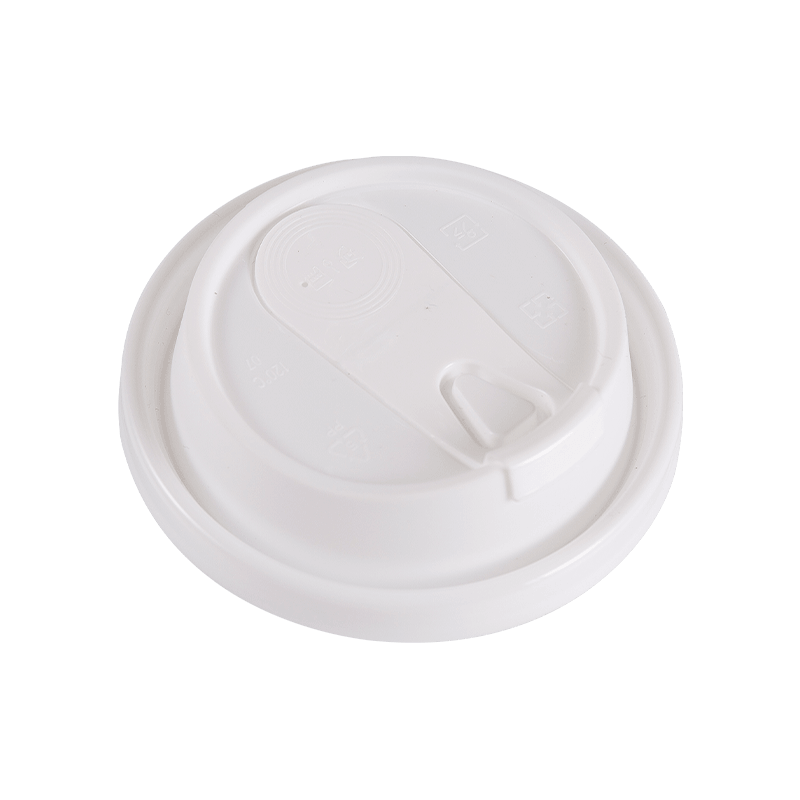 Leak-Proof Injection-Molded PP Cover with Folding StopperThis flexible PP cover uses a folding stopper in U- or V-shape to create a secondary seal at the drinking hole. It suits delivery applications where recurring leaks occur, offering switchable sealing and controlled pouring.View Product →
Material Choice Determines Whether the Seal Holds in Real Transit
Polypropylene (PP) is the most forgiving material for leak-resistant delivery cup covers; PS and PET require tighter rim tolerances, and PLA needs thicker wall sections to avoid brittle fracture at the locking tab.
The material controls two things: how the lid deforms as it snaps over the rim, and whether the seal recovers after a bump. A brittle polymer may crack at the hinge after thirty openings; an overly soft polymer may creep and lose contact pressure at the rim. Product developers should match polymer stiffness to the locking mechanism, not only to cost.
| Material | Flexibility | Heat tolerance | Seal reliability | End of life |
| PP | High | 120 C | High, good for plugs and tabs | Recyclable |
| PET | Moderate | 70 C | Moderate, needs precise fit | Recyclable |
| PS | Low | 90 C | Low to moderate, brittle | Recyclable in limited streams |
| PLA | Low | 45 C | Moderate with thicker walls | Commercially compostable |
PLA can pass leak tests if the supplier increases wall thickness and adds a plug closure. A disposable leakproof PLA hot drink lid with a spout is a workable option for brands committed to compostable packaging, provided the beverage temperature stays below 45 C. For hot coffee delivery at 65-75 C, PP remains the safer engineering choice.
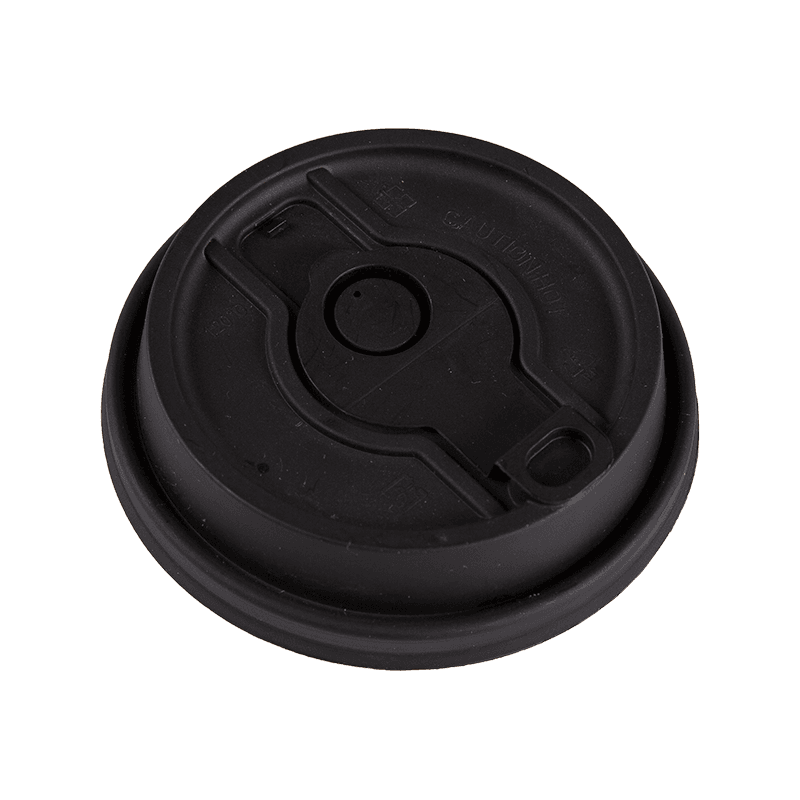 Disposable PLA Hot Drink Lid with Leak-Proof Straw CoverThis compostable PLA lid with a silicone straw cover suits brands prioritizing eco-friendly packaging. It provides leak resistance for cold or warm drinks below 45°C, but check temperature limits if used for hot coffee delivery.View Product →
Factory Tests and Order Specifications That Verify Spill Resistance
Leak resistance should be proven with pressure, drop, and vibration tests before you approve a lid design, not discovered through customer complaints after launch.
At Xuancheng Bo Site Commodity Co., Ltd., routine qualification for a new delivery cup cover includes four checks:
- Static pressure test at 5-8 psi for 60 seconds with water, not air, because air escapes through gaps that liquid will not.
- One-metre drop test onto a hard surface with a filled cup, checking for both leakage and lid separation.
- Vibration test for 30 minutes on a shaker table that simulates stacked delivery bags in a courier box.
- Thermal cycle test: fill with 75 C liquid, close the lid, cool to 20 C, then check whether the vacuum or pressure change unseats the cover.
Order specification. Write this into your RFQ: the lid must hold 6 psi without leakage and survive one-metre drop and 30-minute vibration tests. That single sentence eliminates most low-cost covers that only look right on a sample photo.
Material suppliers, lid moulders, and cup manufacturers must be aligned on rim diameter and wall thickness. A complete guide to cup cover materials, fit, and branding covers the specification checklist in more depth.
Frequently Asked Questions
Why do delivery cup covers leak even when they seem to fit?
Visible fit is not the same as contact pressure. The lid can snap onto the rim yet lose its seal at the sip hole or vent, or the cup rim can be out of tolerance by less than a millimetre. Fill level is the other variable: an overfilled cup pressurizes the cover from inside and forces liquid through the smallest gap.
What is the right headspace for delivery drinks?
Use 5-10 mm for hot drinks and 8-12 mm for cold drinks with ice. Cold drinks need extra room because ice shifts during transport and creates irregular pressure on the lid.
Can the same lid serve hot and cold drinks?
Only if the material and geometry tolerate both. A PP lid with a plug closure works across hot and cold beverages, while PS flat lids are best limited to hot drinks and PET lids to cold drinks. Check the heat tolerance and the vent design before assigning one SKU to both use cases.
Are PLA cup covers as leak resistant as PP?
Not at equal wall thickness. PLA is stiffer and more brittle, so it needs thicker sections at the locking tab and plug to pass the same pressure test. At a 6 psi requirement, a well-designed PLA lid can comply, but PP remains the lower-risk choice for hot delivery drinks.
Final note. Start with a 90 mm PP lid with a plug closure on a cup you can certify, then collect driver feedback for two weeks before scaling to your full store network.

 +86-0563-8029081

 +86-0563-8029081
 No. 12 Sanxi Road, Xinqiao Development Zone, Jingde Country, Xuancheng City, Anhui Province.
