
 English
 Español
 عربى
A failure pattern repeats in real takeaway kitchens: a restaurant buys 750 ml kraft paper bowls with transparent PET lids, serves cold salads for three weeks, then tests the same bowl with hot miso soup. The lid warps within ten minutes, the seal bulges, and the courier reports a leaking bag. The bowl is fine; the lid is the problem. Matching lids to paper bowls for hot soups vs. cold salads means checking four variables no label shows: rim geometry, heat tolerance, moisture behavior, and grease resistance.
Content
- 1 Matching Lids to Paper Bowls Starts with Rim Geometry, Not Capacity
- 2 Hot Soups vs. Cold Salads: The Lid Requirement Matrix
- 3 How to Match Lids to Paper Bowls for Hot Soups: The 90 C Standard
- 4 How to Match Lids to Paper Bowls for Cold Salads: Clarity and Grease Resistance
- 5 Run This 15-Minute Lid-Fit Test Before You Order 50,000 Units
- 6 What a Supplier Must Confirm Before You Commit to a Bulk Order
- 7 FAQ: Lid and Paper Bowl Matching Questions
Matching Lids to Paper Bowls Starts with Rim Geometry, Not Capacity
The dimension that decides whether a lid seals is the outer rim diameter of the bowl, measured across the rolled curl, not the volume printed on the bottom. A 500 ml bowl from one factory and a 500 ml bowl from another behave differently because capacity changes with wall taper, height, and base diameter. Three rim diameters cover most takeaway formats: 118 mm for 500-620 ml, 127 mm for 750 ml, and 150 mm for 1000 ml and larger.
The rim of a paper bowl is a rolled curl. Outer rim diameter is the widest point of that curl, measured with calipers across the opening. A lid's locking channel is manufactured to that diameter, with a normal fit tolerance of +/- 0.5 mm. If the lid groove is more than 1 mm wider than the bowl rim, the seal depends on friction alone and fails under steam pressure.
Before investigating lid material, verify these five numbers:
- Outer rim diameter of the bowl, measured twice at 90 degrees to each other
- Inner groove diameter of the lid channel
- Curl height; a taller curl needs a deeper channel
- Wall taper angle, which controls how far the lid seats before it locks
- Stacking shoulder depth, which can block a friction-fit lid
Hot Soups vs. Cold Salads: The Lid Requirement Matrix
Hot soups and cold salads place different loads on the same packaging system: soup tests heat and steam, salad tests grease and clarity, and few lids are equally strong at both. Matching lids to paper bowls for hot soups vs. cold salads comes down to three forces: temperature at fill, vapor pressure inside the closed package, and contact with oil or dressing.
| Requirement | Hot soup takeaway | Cold salad takeaway |
| Fill temperature | 75-90 C at packing | 2-8 C chilled |
| Vapor and condensation | Steam pools on the lid within minutes | Minimal, unless warm delivery bag meets chilled salad |
| Grease contact | Broth films can wick through uncoated paper | Oil dressing migrates along the rim channel |
| Lid clarity | Not required | Required for display counters and delivery photos |
| Dominant failure mode | Lid deformation, seal pop, condensation leak | Rim softening, greasy channel, lid fogging |
| Most reliable lid material | PE-lined paper lid or PP lid | PET lid or flat PE-lined paper lid |
PP (polypropylene) and PE-lined paper sit at the top of the chart. PLA-lined paper suits warm soup but sits close to failure at a rolling boil, and PET is a cold-service material. Treating a clear PET lid as universal is the most common procurement error we see in bowl packaging orders.
Hot soup lid logic: seal first, vent second
A lid that locks tightly but has a controlled vent or a peel-back tab handles pressure peaks better than a solid dome that cannot breathe.
Cold salad lid logic: clarity first, seal second
A clear PET lid does the merchandising work at the display counter, while the bowl rim does the sealing work; dressing resistance lives in the channel geometry.
How to Match Lids to Paper Bowls for Hot Soups: The 90 C Standard
For hot soups, the working standard is simple: the paired lid and bowl must survive a 90 C fill, a 30-minute closed hold, and a one-minute inversion without leaking. At 75-90 C, a PE-lined bowl and a PE-lined paper lid behave predictably because the coating becomes more flexible rather than weaker. PP lids add a mechanical click seal and high heat resistance, which is why soup programs often use the two together.
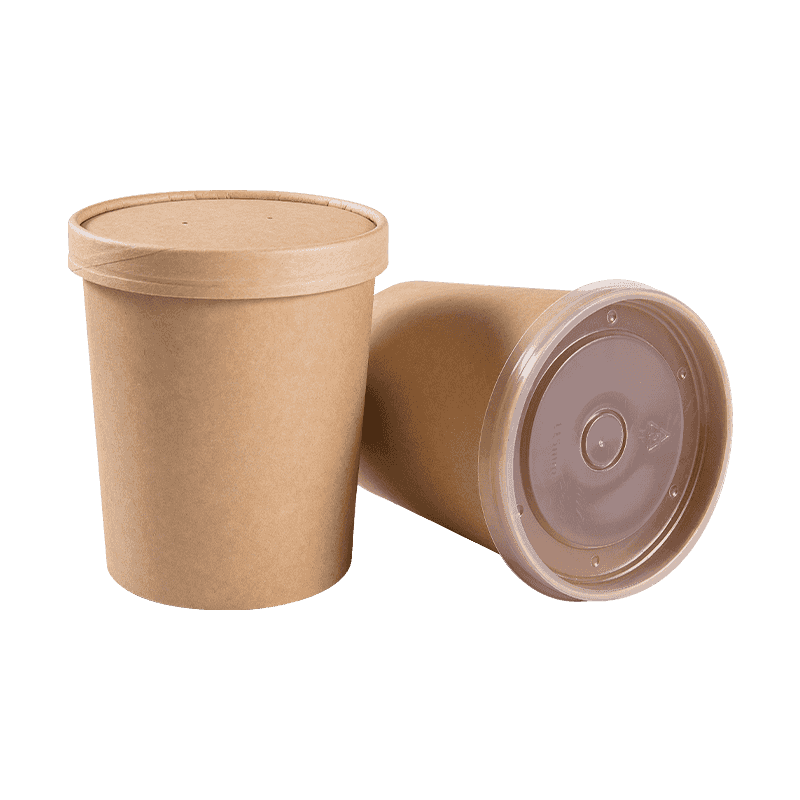 Microwavable Kraft Paper Soup Bowl with Paper CoverThis bowl pairs a kraft paper body with a paper cover for hot soup service. It suits the 90 C fill and 30-minute hold described above, with a design meant to resist leaks and keep contents warm.View Product →
PLA-lined paper has a practical ceiling around 85 C, so it suits warm soups but not boiling broth. PET and PS lids should not appear on the hot-soup line at all. Steam pressure matters just as much: a fully sealed hot lid accumulates vapor and bulges upward, while a lid with a controlled vent or a soft pull-tab keeps the rim seat dry.
Our tests on keeping food delivery boxes warm and leak proof show that a sealed but unvented container loses its lid seal roughly twice as fast as a vented design when the fill is above 80 C.
How to Match Lids to Paper Bowls for Cold Salads: Clarity and Grease Resistance
For cold salads, the lid must stay transparent enough to show the product and resistant enough that oil-based dressing cannot migrate along the rim and soften the seal. PET lids are the standard choice because they stay clear, seat cleanly on 118-150 mm rims, and hold up at chilled temperature.
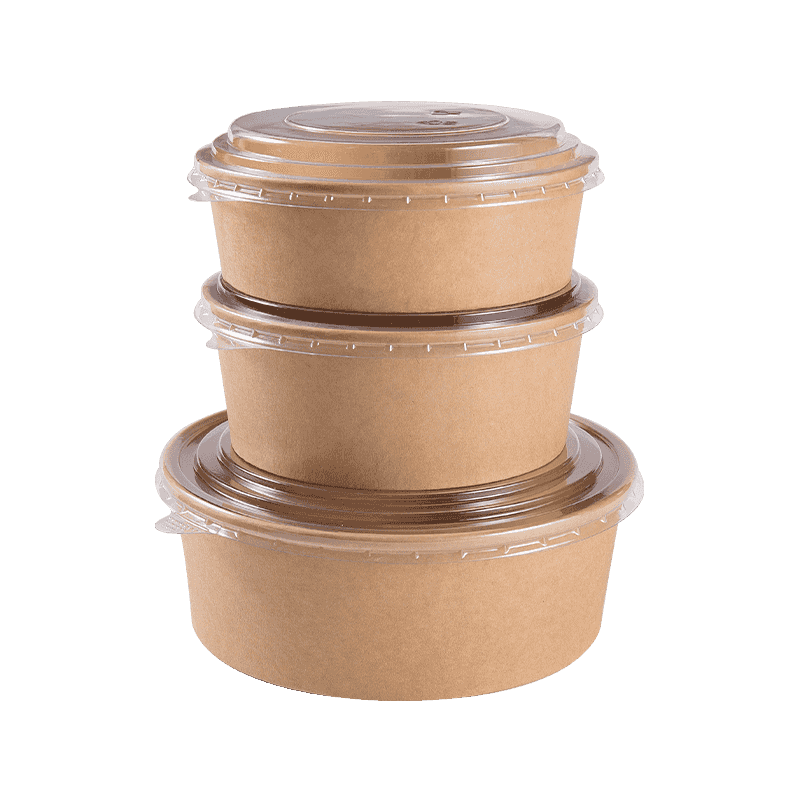 Kraft Paper Salad Bowl with Clear Plastic Lid (500/750/1000ml)Available in three sizes, this salad bowl uses a clear food-grade lid to show contents while resisting oil migration from dressings. Its sturdy kraft body suits chilled salads and takeout, addressing the condensation and sealing concerns noted.View Product →
Olive oil, sesame dressing, and creamy sauces wick along paper fibers by capillary action. A narrow lid channel leaves a gap where dressing pools and attacks the coating seam. Flat paper lids are cheaper and compostable, but they fog and absorb moisture vapor over time; a salad packed at 4 C and held in a warm delivery bag for 20 minutes develops condensation that PET does not absorb.
Dressing migration is the quiet killer of cold salad seals: a bowl that passes a clean-water test can fail within minutes when the rim contacts 30 g of oily dressing. Test with the actual vinaigrette.
For a compostable option, start with a square or octagonal kraft salad bowl with a fitted lid from the same production line; a square rim needs a lid made for that specific rim, not a round-bowl lid. Our comprehensive guide to kraft paper salad bowls covers material and sizing options in more detail.
Run This 15-Minute Lid-Fit Test Before You Order 50,000 Units
Every bulk order should pass the same five-step lid-fit test before approval. It takes 15 minutes with a caliper, a thermometer, and a sink; a supplier's spec sheet confirms intent, but this test confirms the actual pair.
- Measure both diameters. Outer rim of the bowl and inner groove of the lid; a difference of 0 to 0.5 mm is the target, above 1 mm means the lid size is wrong.
- Fill at serving temperature. Hot test at 90 C, cold test at 4 C. Close the lid once and do not re-snap it.
- Hold for 15 minutes. Note dome rise, condensation pooling, rim softening, and flex in the curl.
- Tilt and invert. Tilt 30 degrees for 60 seconds, then invert for 10 seconds; wetting on the lid channel or bowl rim is a fail.
- Stack five closed units under 1 kg for 5 minutes. Each lid seat must stay level and the locking ring must not deform.
Do the final check under delivery conditions: pack a filled unit, ride a route for 15 minutes, and open it at the drop point. The driver's bag is where seals actually fail.
What a Supplier Must Confirm Before You Commit to a Bulk Order
A reliable manufacturer can confirm rim geometry, lid material ratings, and matched stock sets in writing. If the supplier cannot produce these numbers, treat the order as high risk regardless of unit price.
Xuancheng Bo Site Commodity Co., Ltd. (papercup-factory.com) is a container manufacturer in Anhui, China, producing paper cups, bowls, and containers since 2008. The company exports to Europe, the United States, the Middle East, and South America, states an annual capacity of one billion pieces, and lists 10 invention and 10 utility-model patents. Its line covers PE-lined, PLA-lined, and water-based barrier coatings, so lid and bowl materials are specified as one system.
Request these documents before signing the purchase order:
- Technical drawing or spec table with rim diameter and curl height per size
- Food-contact statement covering both lid and bowl materials
- Results of the 90 C fill test and a grease migration test, or a field-leakage warranty
- Confirmation that the lid and bowl were tested as a matched stock set
- Physical samples for your own 15-minute test before production
A stock-matched set from the same factory removes the largest variable in lid-bowl failures: the assumption that two compatible-looking products from different catalogs will fit together.
FAQ: Lid and Paper Bowl Matching Questions
Can I use the same lid for hot soup and cold salad if the rim diameter matches?
Only if the lid material is rated for the hot side. A clear PET lid fits a cold salad bowl, but it softens above 65 C and should never meet soup at 90 C. Rim compatibility is necessary, not sufficient.
Which lid has the best heat resistance for soup bowls?
PP lids and PE-lined paper lids. PP tolerates roughly 110 C and adds a click-seal feel; PE-lined paper stays safe in the 90-95 C range and keeps the package paper-based. Avoid PET and PS above 75 C.
Why does my salad bowl leak only when dressing touches the rim?
Oil-based dressing migrates along paper fibers and softens the seal channel. Specify a wider curl and a lid whose channel seats below the dressing contact line; this is why suppliers ask you to test with real food.
How many samples should I test before a bulk lid order?
Minimum five bowls and five lids per size, using the exact combination you plan to order. Test one set at 90 C soup fill, one at 4 C salad fill, one after 20 minutes in a delivery bag, and one under a five-unit stack.
If a supplier cannot confirm rim diameter, lid material rating, and matched-set test results in writing, request a different supplier before you request a price.
 +86-0563-8029081

 +86-0563-8029081
 No. 12 Sanxi Road, Xinqiao Development Zone, Jingde Country, Xuancheng City, Anhui Province.
