
 English
 Español
 عربى
Fast food is judged in the first few minutes after it leaves the counter. A bun that has turned damp, fries that have gone limp inside a sealed carton, or a fried coating that slides away in grease all point to the same culprit: the package. Hamburger boxes and french fry cups are not passive containers. They manage steam, grease, heat and stacking pressure, and small design differences decide whether a meal reaches the customer crisp or soggy.
This guide explains how the two formats actually work, which boards and coatings carry the load, and what to verify before placing a bulk order.
Content
- 1 Why Crispiness Is Really a Moisture Problem
- 2 How Hamburger Boxes Protect the Bun
- 3 French Fry Cups: Open Tops, Tight Barriers
- 4 Format Comparison at a Glance
- 5 Sides, Sharing Trays and the Delivery Envelope
- 6 Coatings, Compliance and the PFAS Question
- 7 A Practical Checklist Before Ordering
- 8 Frequently Asked Questions
- 9 Sourcing Notes for Bulk Orders
Why Crispiness Is Really a Moisture Problem
Crispness is a surface property. A fry stays crunchy while its outer crust remains dry and its internal moisture stays inside. Once water migrates outward, starch rehydrates, the crust softens, and the texture does not come back. Three mechanisms drive that migration.
Steam forms faster than it can escape
Fried and griddled food keeps releasing vapour after cooking. A patty, a warm bun and a portion of fries can together release several grams of water within the first ten minutes. Inside a closed carton, relative humidity climbs toward saturation and condensation collects on the coolest surface, usually the lid directly above the food. A single drip onto a bun creates a soft patch that customers notice immediately.
Grease moves through fibre, not just onto it
Hot oil drops in viscosity and wets the board. Uncoated stock absorbs it, turns translucent, loses stiffness and can strike through the outer print. A grease-saturated wall also conducts moisture, so a cup that fails on grease almost always fails on texture.
Stacking pressure finishes the job
Delivery bags are filled, tilted and stacked. A carton that bows under load presses food against its walls, squeezes out oil and closes the air gaps that keep surfaces dry.
How Hamburger Boxes Protect the Bun
Burger packaging most often takes the form of a one-piece clamshell, a sleeve with a tray, or a tuck-front carton. The clamshell dominates takeaway because it holds shape under stacking and can be vented. Its job is to keep the bun tender without letting the crust go wet, and that balance is set by four details.
Vent placement and height
Vents belong high on the side wall, where rising vapour collects. Vents near the base simply leak grease onto the bag and the customer's hand. Two to four holes of roughly 3 to 5 mm along the upper edge are usually enough for a single burger, and they should be punched after coating so the barrier is not fractured around the rim.
Board weight and air gap
Most burger cartons run at 300 to 350 gsm kraft board. Ripple or E-flute versions add about one millimetre of still air, which slows heat loss and keeps the lid clear of the bun crown. Below 280 gsm, a loaded carton tends to bow once it is stacked three or four high in a delivery bag.
Barrier on the inside, print on the outside
Grease resistance belongs on the food-contact surface. Polyethylene gives the most predictable performance, PLA suits compostable programmes, and water-based dispersion coatings keep the board suitable for fibre recycling where local mills accept coated stock. A separate burger wrap still helps, because it absorbs surface oil before the carton ever sees it.
Buyers who are comparing board grades and barrier options will find a useful reference in this analysis of food-grade kraft paper hamburger packaging, which covers material safety and structural choice in more detail.
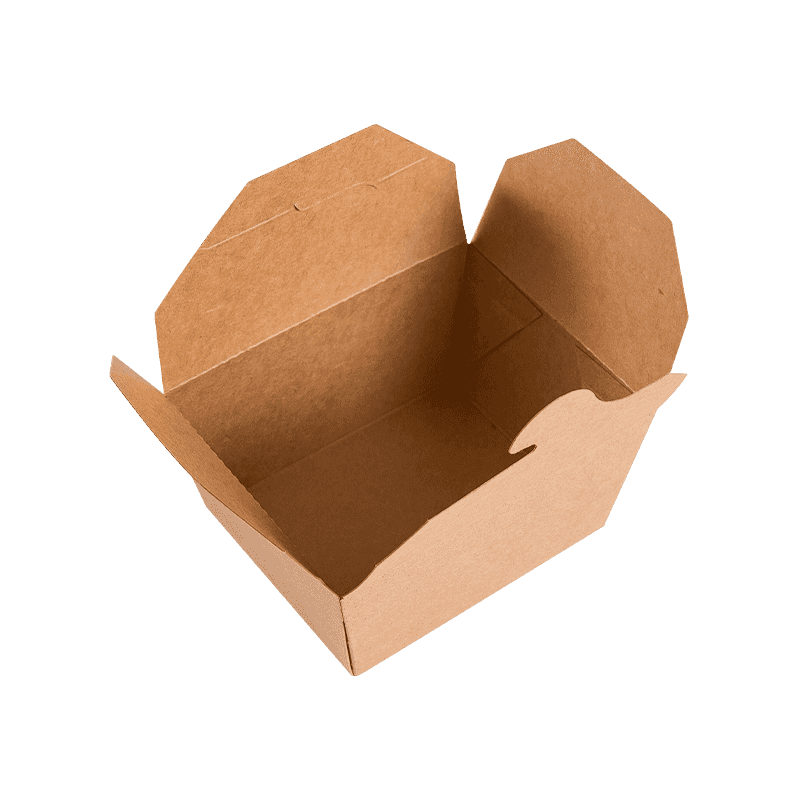 Food-Grade Kraft Paper Burger Packaging BoxesThese disposable kraft burger boxes offer a reinforced bottom and hygienic opening design, making them relevant for fast-food packaging and environmentally minded service.View Product →
French Fry Cups: Open Tops, Tight Barriers
Fry packaging is the opposite design problem. A fry cup is expected to breathe, because the customer eats within minutes and steam has no time to condense. The barrier still matters, since oil pooling at the base of the cup can soak through in under two minutes.
Open tops release vapour by design
A scoop-style cup vents naturally. Here the board's grease resistance, not its sealing, does the work. Cups that will be bagged for delivery need a different approach, typically a paper lid with small vent holes rather than a fully sealed dome that traps steam directly above the fries.
Fill height and headspace
Overfilling is a common cause of sogginess. Leaving 10 to 15 mm of headspace keeps the top layer of fries away from the lid and gives vapour somewhere to go. Cup sizes from 8 oz to 16 oz cover most single and sharing portions, and a wider diameter improves stability when the bag is carried at an angle.
Liners and board selection
A greaseproof liner inside a kraft cup provides a replaceable barrier and lets the outer cup stay uncoated for easier recycling. Board of 250 to 300 gsm with a kit rating of 5 or above handles typical fry loads, while heavier stock resists the outward pressure of a full cup.
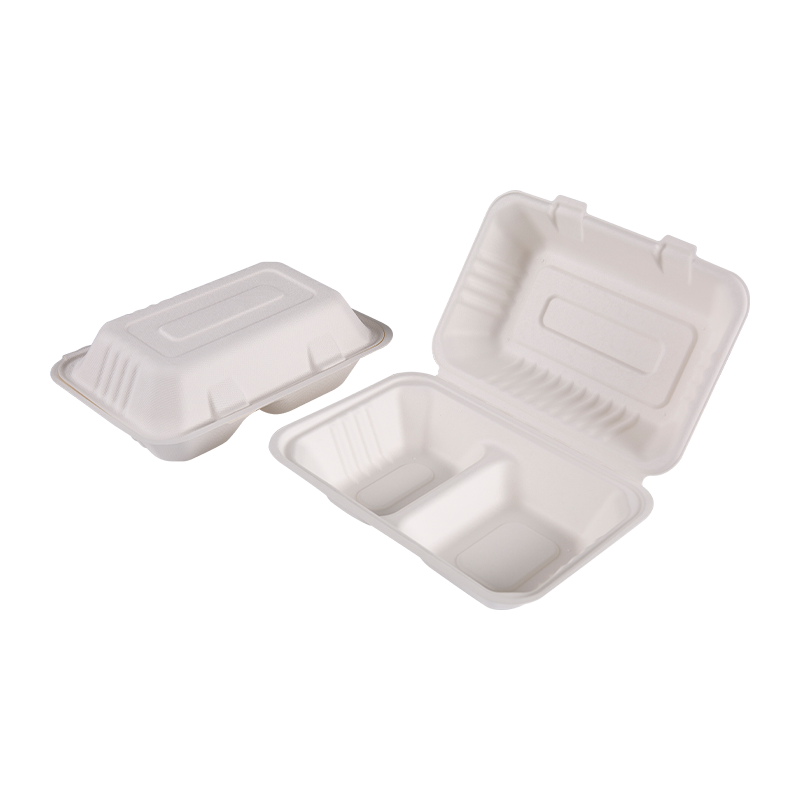 French Fire Cup Paper Packaging CategoryThis category page lists French Fire Cup paper packaging and related custom options, useful for comparing fry-cup formats alongside board and liner considerations.View Product →
Format Comparison at a Glance
The table below summarises how the main formats behave in a typical quick-service setting.
| Format | Typical board | Barrier | Ventilation | Best used for |
|---|---|---|---|---|
| Burger clamshell | 300 to 350 gsm kraft | PE, PLA or water-based coating | 2 to 4 vents on upper wall | Burgers, chicken sandwiches |
| Fry cup or scoop | 250 to 300 gsm plus liner | Grease-resistant coating and liner | Open top | Fries, onion rings, small sides |
| Boat tray | 250 to 300 gsm kraft | Grease-resistant coating | Open top | Shared sides, nuggets, loaded fries |
| Vented fry carton | 300 gsm plus paper lid | Coated board | Small holes in lid | Delivery fries and combo meals |
Sides, Sharing Trays and the Delivery Envelope
Shared sides and combo meals create a third problem: several hot items with different moisture loads sitting next to each other in one bag. Boat trays and open cartons help because they keep portions separated and allow vapour to leave each item rather than accumulating inside one large box.
For delivery, the outer bag becomes part of the system. Paper bags with flat handles and no plastic film let the whole package breathe, while fully sealed bags trap steam from every item inside. Where sealed bags are required for security or temperature control, vented cartons and open-top cups placed inside them reduce the damage.
Choosing between tray, boat and carton usually comes down to menu fit and freight cost. A look at the cardboard food tray range shows how size and flute options change both stack height and the amount of product a pallet can carry.
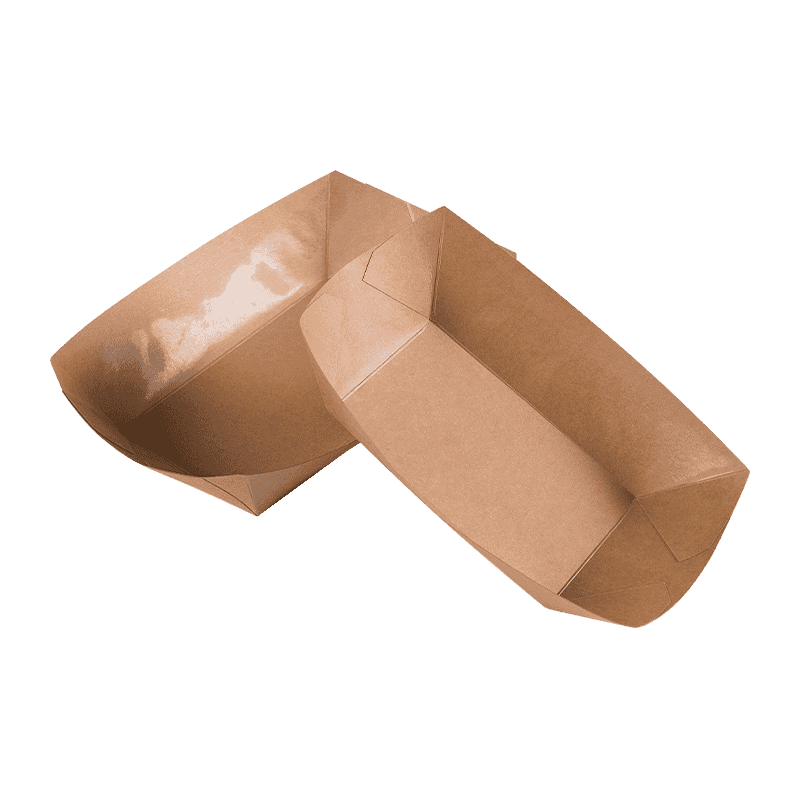 Kraft Paper Boat Trays for Fried Chicken and FriesThese oil-resistant kraft boat trays suit fried chicken, fries and snacks, with a reinforced base for hot, greasy takeaway service and sustainable disposal.View Product →
Coatings, Compliance and the PFAS Question
Food-contact compliance is not optional in this category, and it differs by market. European buyers typically expect compliance with EU 1935/2004 and, where a polymer layer is present, regulation 10/2011, supported by a declaration of compliance and migration test data. US buyers look for FDA food-contact status for both base paper and coating, and many chains now request a PFAS-free declaration. Chinese suppliers work to GB 4806.8 for food-contact paper and board.
Practical checks include:
- Written coating composition and food-contact statement
- Grease resistance results, ideally a kit rating plus a real-food trial
- Heat tolerance for PLA-coated stock, which softens sooner than PE
- Repulpability or compostability certification behind any sustainability claim
Claims should match the market. Compostable usually means an industrial standard such as EN 13432 in Europe, while recyclable depends on whether local mills accept coated board in their furnish.
A Practical Checklist Before Ordering
Specifications that look identical on paper can behave very differently on a counter. Work through this list before confirming a production run.
Test with real food, not empty boxes. A carton that feels rigid when empty can deform within eight minutes under a stacked delivery bag.
- Run a holding test. Fill samples with a hot burger or a 150 g fry portion and hold them for 15 minutes inside a closed bag.
- Confirm the barrier side. Check that the coating sits on the food-contact surface, not only on the print side.
- Match vents to the menu. More vents for fried items, fewer for saucy burgers where leakage is the bigger risk.
- Review stack strength. Load cartons four high and look for bowing, corner crush or lid contact with the bun.
- Calculate freight cube. Nested cups and flat-packed clamshells can cut shipping volume substantially.
- Approve print on production stock. Kraft board shifts ink tone, so a proof on the actual material matters.
Frequently Asked Questions
Q1: Why do fries go soft in a closed box but stay crisp in a cup?
A closed box traps vapour in a small headspace, so humidity reaches saturation and condensation falls back onto the fries. An open cup lets vapour leave continuously, keeping the surface crust dry.
Q2: Are vented burger boxes still safe for delivery?
Yes. Small upper vents release steam without weakening the carton, provided the holes are punched outside the food-contact area and the board still meets stack strength requirements. For very long deliveries, a wrap inside the carton adds a useful oil and moisture buffer.
Q3: Which coating keeps a fry cup from leaking oil?
Polyethylene is the most predictable performer, PLA works well for compostable programmes with careful heat management, and water-based dispersion coatings suit recycling-focused buyers. A greaseproof liner can supplement any of them.
Q4: Can one carton serve both hot and cold items?
It can, but performance will be a compromise. Cold items create condensation on the outside of the pack, while hot fried items need venting. Separate formats usually deliver better texture and fewer complaints.
Sourcing Notes for Bulk Orders
Board grade, coating type and vent placement can only be validated together, which is why a sample run on your own menu items is more valuable than a specification sheet alone. The company behind this site, Xuancheng Bo Site Commodity Co., Ltd., manufactures paper cups, burger cartons, fry cups, trays and food containers at its facility in Jingde County, Anhui Province, with more than 50 paper cup machines, moulds for over 40 cup and bowl shapes and a stated annual capacity of about one billion pieces. Products are exported to Europe, the United States, the Middle East and South America, and the plant holds production and hygiene licences for food-contact paper containers.
A sensible order sequence is straightforward: test samples with real food, confirm compliance documents for the destination market, then lock board weight, coating, vent layout and tolerances into the purchase order so that every reorder performs the same way.

 +86-0563-8029081

 +86-0563-8029081
 No. 12 Sanxi Road, Xinqiao Development Zone, Jingde Country, Xuancheng City, Anhui Province.
