
 English
 Español
 عربى
عربىThe food service industry is abandoning plastic at an accelerating pace, and the eco friendly food packaging container has moved from a niche alternative to a mainstream necessity. These containers are designed to hold hot meals, cold salads, soups, and snacks while breaking down safely after disposal — either in a compost pile or a recycling stream. What sets them apart is not just the raw material, but the entire lifecycle: a biodegradable food packaging container made from renewable plant fibers or recycled paper can reduce the carbon footprint of a single takeaway meal by 30–50% compared to conventional plastic clamshells. As regulations tighten and consumers demand sustainability, switching to the right paper‑based solution is both an operational decision and a brand statement.
Content
Understanding Biodegradable, Compostable, and Sustainable Paper Food Packaging
The terms biodegradable food packaging container, compostable food container, and sustainable paper food packaging are often used interchangeably, but they describe distinct end‑of‑life pathways. Biodegradable simply means that a material can be broken down by microorganisms over an unspecified period, with no guarantee of complete decomposition or non‑toxicity of residues. Compostable is a stricter, certified standard: a compostable food container must disintegrate by at least 90% within 12 weeks and biodegrade within 6 months under industrial composting conditions, leaving behind no harmful substances. Certifications like EN 13432, BPI, and OK Compost verify these claims.
Sustainable packaging goes beyond the material itself to consider the full lifecycle — sourcing, manufacturing energy, transport weight, and end‑of‑life options. A kraft paper food container made from unbleached, FSC‑certified virgin or recycled fibers, with a water‑based grease barrier, scores highly on sustainability metrics. Kraft paper uses the sulfate pulping process, which recovers and reuses chemicals, and it retains its natural brown color without chlorine bleaching. This eliminates the dioxin pollution associated with bleached white paperboard, while the container itself remains robust enough for heavy takeaway meals.
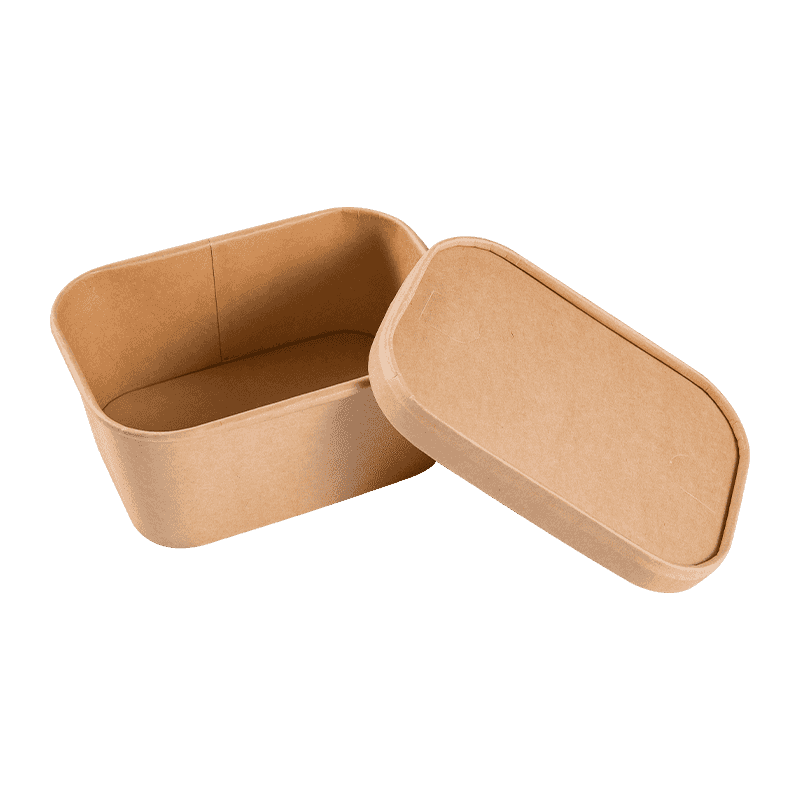
Performance Features: Leak Proof, Grease Resistant, and Microwave Safe
For a paper food container with lid to work in a real‑world delivery scenario, it must prevent leaks, resist grease penetration, and ideally allow reheating. Modern eco‑friendly containers achieve this through advanced barrier coatings without relying on traditional polyethylene (PE) plastic. A leak proof food container typically uses an aqueous dispersion coating made from modified starches, aliphatic polyesters, or polylactic acid (PLA). These coatings are thin enough to remain repulpable yet effective enough to hold hot gravy or curry for over an hour without softening.
Grease resistance is equally critical. A grease resistant food container must prevent oil from fried items from wicking through the paper and staining the outside of the container — a common failure mode of untreated paperboard. Fluorochemical‑free grease barriers are now the industry standard, relying on densified paper layers or bio‑based coatings that achieve a Kit rating of 6–12, sufficient for even heavily sauced foods. Meanwhile, a microwave safe food container must withstand internal food temperatures of at least 100°C (212°F) without the coating breaking down or the structure warping. PLA‑lined paper containers are generally safe for microwave reheating, though prolonged exposure above 120°C should be avoided. Many brands now print clear “microwave safe” labels on the base, removing guesswork for the end customer.
The addition of a secure, well‑fitting lid transforms a simple bowl into a complete paper food container with lid system. Lids may be made from matching kraft paperboard, clear PLA bioplastic for product visibility, or molded fiber for full compostability. Vent holes in the lid prevent steam buildup that would otherwise soften the container walls, maintaining structural integrity during delivery. When a container lid is tightly sealed, the risk of leakage drops to near zero, even when the package is jostled in a delivery bag.
Paper Container vs Plastic Container: An Environmental and Functional Comparison
The choice between a paper container vs plastic container is no longer a matter of simple cost — it involves carbon footprint, marine pollution, consumer perception, and increasingly, legal compliance. The table below quantifies the key differences between a typical kraft paper food container with a bio‑based coating and a standard polypropylene (PP) or polystyrene (PS) container used for takeaway.
| Criteria | Eco Friendly Paper Container | Plastic Container (PP/PS) |
|---|---|---|
| Raw material source | Renewable (wood fiber, bamboo, bagasse) | Fossil fuel (oil, natural gas) |
| Carbon footprint (kg CO₂ per ton) | 600–1,200 (varies with recycled content) | 2,500–4,000 |
| Biodegradability | Biodegradable in compost within 3–6 months | Virtually non‑biodegradable; persists 400+ years |
| Recycling practicality | Widely accepted in paper streams if coating permits | Technically recyclable but often contaminated with food, rarely recycled |
| Leak resistance | Excellent with modern bio‑coatings | Excellent (inherent property) |
| Microwave safety | Yes, if certified microwave safe | Varies; PS may release styrene; PP is generally safe |
| Consumer perception | Highly positive; associated with eco‑consciousness | Increasingly negative; seen as environmentally harmful |
From a cost perspective, an uncoated kraft paper food container may be slightly more expensive per unit than an equivalent polystyrene clamshell — the premium is typically 10–25%. However, when accounting for the regulatory fees and the marketing value of visible sustainability, the total cost difference narrows sharply. Cities such as San Francisco, Seattle, and Vancouver have already banned polystyrene food containers, and the European Union's Single‑Use Plastics Directive is phasing out many plastic packaging items entirely. A switch to sustainable paper food packaging is thus not only an environmental choice but a compliance investment that protects against future legislative risk.
How to Choose the Most Sustainable Paper Food Container
When selecting an eco friendly food packaging container, look beyond the green label and check the following attributes to ensure genuine sustainability and functional performance:
- Fiber source certification: Choose kraft paper food container products certified by the Forest Stewardship Council (FSC) or the Programme for the Endorsement of Forest Certification (PEFC). This ensures the wood fiber comes from responsibly managed forests, not illegal logging or ancient woodland conversion.
- Barrier coating type: For a compostable food container, avoid PE linings. Look for containers with PLA, aqueous dispersion, or bio‑wax coatings. These maintain the leak proof and grease resistant properties needed for food service while allowing the container to decompose in a commercial composting facility.
- End‑of‑life compatibility: Verify that the product matches your local waste infrastructure. A biodegradable food packaging container that is only biodegradable in an industrial composter has limited value if your community lacks such facilities. Home‑compostable certifications (such as OK Compost HOME) are increasingly available and more widely applicable.
- Lid and closure integrity: A paper food container with lid should pass a 90‑degree tilt test without leaking. For delivery operations, containers that have a snap‑fit or lock‑tab lid provide far greater protection against spills than simple loose‑fit covers.
- Heat tolerance: If the container will hold hot food straight from the kitchen, confirm it is rated for at least 100°C. Microwave safe food container labeling indicates the coating will not melt or leach into the food during normal reheating, a feature that customers increasingly expect.
Finally, consider the overall design and stacking efficiency. A sustainable paper food packaging line that uses standardized lid sizes across multiple base volumes can reduce inventory costs and simplify ordering. Containers that nest compactly save warehouse space and cut transport emissions. By evaluating the full package — material health, certification, functional barriers, and logistics — a food business can confidently claim to use an eco friendly food packaging container that performs as well as it degrades, protecting both the meal and the planet.

 +86-0563-8029081
 +86-0563-8029081
 No. 12 Sanxi Road, Xinqiao Development Zone, Jingde Country, Xuancheng City, Anhui Province.